



Chart of the Day
Good morning!
During his first term in office, President Trump asserted that he had exerted “maximum pressure” on Iran, at least in a non-military sense, to end Tehran’s nuclear ambitions. The proper description for this week’s latest efforts “is, presumably, maximum plus,” as The Economist wryly suggested.
In all seriousness, perhaps it is. If Trump sought to pressure Iran during his first term in office, this week saw implied threats against other countries that are deemed to have been helping Iran, which was largely expected. On Tuesday, my colleague Hardika Singh discussed the most obvious likely target, China – though Treasury Secretary Scott Bessent did not identify any countries by name in his remarks. However, the Middle Kingdom is not the only one that experts believe to have provided a (limited) financial lifeline for Tehran.
Hardika argued that China’s status in global oil markets gives China the unique ability to cause pain to the U.S. economy if it’s forced to fully comply with U.S. sanctions against Iran. Perhaps more importantly for our discussion today, China believes – correctly, and not just due to its dominance in refining rare-earth materials – that it has sufficient economic leverage to make the U.S. think twice before coming down hard on China for any allegedly illicit oil purchases or financial transactions in which it might engage with Iran.
China’s not the only one. Other countries that are likely objects of the White House’s ire include Turkey, India, and Malaysia.
Yet Turkey, which for a millennia has been one of the most strategically important countries in the world due to its key location, has never been one to obediently comply with demand or requests from the West. Or East. Instead, the modus operandi of whoever rules the gateway between East and West has always been to play both sides against each other, and there’s no reason to assume this time will be any different.
The U.S. still needs Turkey, after all.
Within NATO, only the U.S. has a larger military, and Turkey is host to the U.S. Air Force’s forward airpower and logistics hub (and, it is widely believed though unconfirmed, several dozen U.S. tactical nuclear bombs). Trump knows this: It’s why he’s signaled a willingness to consider selling Ankara cutting-edge F-35 stealth fighters, even if it received strong opposition from Israeli Prime Minister Benjamin Netanyahu.
As for India, the government there correctly sees itself as not just the world’s largest democracy, but also critically important to the U.S. as a counterweight to China. The Trump administration has already been aggressive in its trade stance with India, and Prime Minister Narendra Modi’s reaction to U.S. August 2025 punitive actions over India’s purchases of Russian oil suggest that the U.S. has reached the limit of how much pressure it can exert without consequence: Modi promptly got on a plane to go visit Xi Jinping and later hosted Vladimir Putin in New Delhi.
Then there’s Malaysia. Much of the physical logistics surrounding the illicit purchases of Iranian oil involve ship-to-ship transfers in waters off the coast of Johor (where a jurisdictional gray zone complicates enforcement efforts). Kuala Lumpur has far less influence in Washington, D.C., than Beijing, Ankara, or New Delhi. However, the country can very accurately claim that it lacks the military capabilities to do any more to prevent such transfers than it already has. Nor is it a good idea to send U.S. warships to assist, risking a diplomatic incident with both Malaysia and Singapore (a key U.S. defense partner). All of these mean that hitting Malaysia with punitive financial measures is unlikely to have much impact beyond alienating Malaysia.
That’s not to say Bessent and Trump are wasting their time. The “Economic D-Day” might not cause targeted countries to pay more than lip service to U.S. demands. However, the slight added effect on the already struggling Iranian economy could be a proverbial straw that breaks the camel’s back.
Or not. He is almost certainly whistling in the dark, but it’s not unreasonable to consider a question posed by Mohsen Rezaei, the new, hardline Iranian national security adviser. “What does [President Trump] want to do that he has not done before?” It’s clearly not sanctions.
Share your thoughts
Will this latest “Economic D-Day” be enough to force Iran’s final capitulation? Click here to send us your response.
📧✍️Here’s what a reader commented📧✍️
Q: Do you think Elon Musk can meet his deadline this time and actually deliver on his promise of a satellite-based server?
A: The Magic 8 Ball says “Unlikely!” History says Elon will slip his aggressive Q4 2027 schedule for the SpaceX AI1 satellite data center in space. He gives his teams very lofty goals——almost dreams. When he announced he’d create affordable electric cars, self-driving cars, reusable rockets that self-land, launch towers that catch returning rockets with “chopsticks,” and brain implants that control computers and wheelchairs through thought, many people and the media scoffed at these outlandish ideas. But look where we are now. History says he will slip the schedule, but the SpaceX data centers in space will become the de facto standard, leaving data centers on Earth looking like energy-burning, water-chugging, heat-generating eyesores of the past.
Catch up with Fundstrat
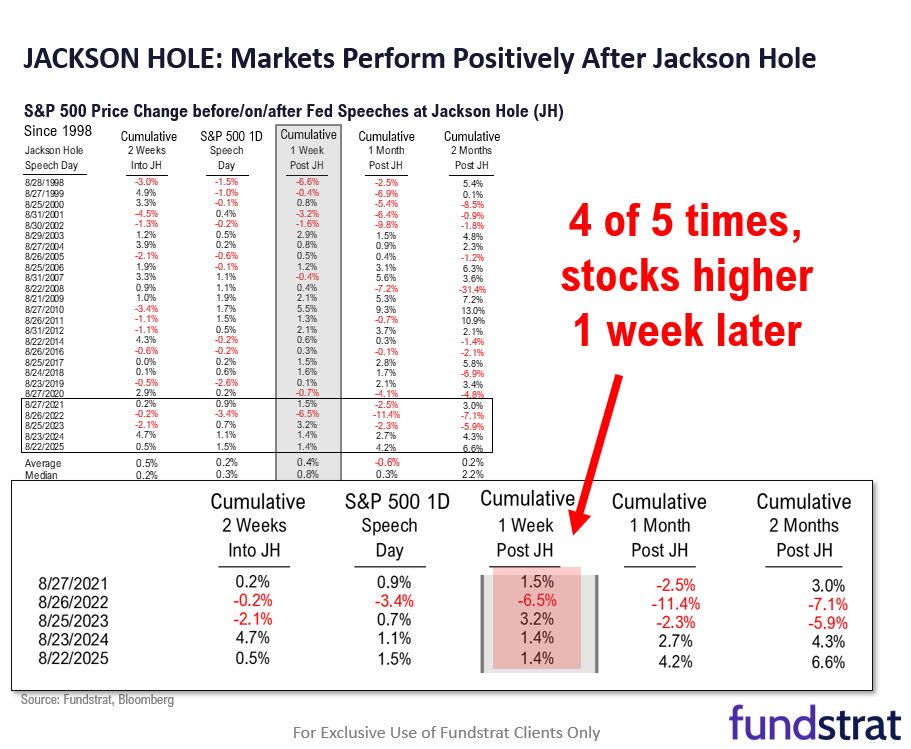
We expect Fed Chair Warsh’s Jackson Hole speech to lead to a market rally. Four of the last five Jackson Hole speeches saw markets gain in the following week.
Technical
NVDA’s move out of the triangle it has been building since May came yesterday on the heaviest volume since late May, though it was software, not semis, that carried technology on the day.
Crypto
I previously laid out the case that the market has likely made its lows and that the broader macro regime is beginning to turn more favorable for crypto. Yesterday’s data and price action did little to change that view. Accordingly, we added another 5% of risk across the model portfolios yesterday, taking cash down to 35%.
News We’re Following
Breaking News
- S&P 500 futures mixed as investors count down to Warsh’s Jackson Hole address CNBC
Markets and economy
- Will Warsh’s Jackson Hole speech be a course correction or detour? REU
- US corporate profits surge to record as worker payouts wilt FT
Business
- Judge rules Trump administration’s blacklisting of Anthropic was unlawful WSJ
- Marvell shares tumble 8% as outlook underwhelms despite 37% revenue growth CNBC
- Lilly diabetes shot Mounjaro wins US approval for heart disease BBG
Politics/U.S.
- Corporate America cut big checks to Trump. Now CEOs fear subpoenas are coming. WSJ
- Trump signs executive order to rename Lake Ontario to Lake America NYT
- Stars and Stripes publisher, editor and reporter sue Pentagon to challenge their firings AP
Overseas
- Norway in national mourning after death of King Harald V BBC
- Death toll rises in Nepal-China border disaster as lake poses new flood threat AP
- France plans urgent aid for farmers hit by heat waves BBG
Of Interest
- Thieves snatch $4 million necklace from Vienna Museum BBG
| Overnight | ||||||||||||||||||||||||||
| ||||||||||||||||||||||||||
| APAC | ||||||||||||||||||||||||||
| ||||||||||||||||||||||||||
| Europe | ||||||||||||||||||||||||||
| ||||||||||||||||||||||||||
| FX | ||||||||||||||||||||||||||
| ||||||||||||||||||||||||||
| UST Term Structure | ||||||||||||||||||||||||||
| ||||||||||||||||||||||||||
| USD HY OaS | ||||||||||||||||||||||||||
|
| Date | Time | Description | Estimate | Last |
|---|---|---|---|---|
| 8/28 | 10:00 AM | Aug F UMich 1yr Inf Exp | 4.4 | 4.3 |
| 8/28 | 10:00 AM | Aug F UMich Sentiment | 51 | 51 |
| 9/1 | 9:45 AM | Aug F S&P Manu PMI | n/a | 53.2 |
| 9/1 | 10:00 AM | Jul JOLTS | 7380 | 7359 |
| 9/2 | 10:00 AM | Jul F Durable Gds Orders | 0.5 | 1.1 |
| 9/3 | 8:30 AM | Jul Trade Balance | -74.5 | -73.261 |
| 9/3 | 8:30 AM | 2Q F Nonfarm Productivity | 1.4 | 1.4 |
| 9/3 | 8:30 AM | 2Q F Unit Labor Costs | 1.3 | 1.3 |
| 9/3 | 9:45 AM | Aug F S&P Srvcs PMI | n/a | 56.8 |
| 9/3 | 10:00 AM | Aug ISM Srvcs PMI | 54.3 | 54.1 |