



Chart of the Day
Good morning!
A big reason why Federal Reserve Chair Kevin Warsh was able to justify hiking interest rates yesterday is because according to the committee, the labor side of their dual mandate is doing OK, meaning that the economy is in a position to handle higher rates.
But a closer look suggests that a pause might have still been a better move.
The labor market is widely being described as resilient rather than weak, because jobs in the healthcare and social-assistance sector just won’t let up. But the plentiful career opportunities in that category have increasingly started to resemble retail gigs. Since December 2024, the healthcare and social-assistance sector has added a net 998,900 jobs through July 2026, one of the biggest contributors to the overall increase of 597,000 jobs through that period.
While the sector once used to be synonymous with economic stability and job security, it’s no longer a surefire path to American prosperity for all types of workers in it. Like retail jobs, you can always count on the healthcare sector if you need a fallback option, and some healthcare jobs don’t even require you to slog through years of school. You can become a certified nursing assistant or home health aide after a handful of weeks of study, for example. Unfortunately, that also means that some of those jobs are low paying and have unrealistic quotas to be filled each day.
There was once a time when a job in the broader health sector wasn’t about the administrative burden and the fast clinical pace, but an aging U.S. population and a gradual pivot from healthcare companies toward maximizing profits has inexplicably altered the industry’s decades-old reputation. Not to mention that healthcare workers often have to deal with rude patients and customers, just like retail workers.
Most of that burden is being carried by women. Within the total growth posted in healthcare, 753,8000 jobs were held by women, three times as many as the 245,100 by men. Specifically in the healthcare segment, women have gained 474,300 jobs, while men lag at 125,400. The same trend is persistent in the social-assistance category, as well, with women at 290,600 jobs and men at 108,600.
Jobs in healthcare are also the main reason why women have led labor market growth over men since December 2024. Out of the 597,000 total jobs added since then, 607,000 jobs were held by women compared to the net 10,000 jobs lost by men.
I’ve been saying this for months, but it’s not exciting to see job growth in the healthcare and social-assistance sector. It’s a mechanical increase. What’s more, because these aren’t the types of jobs driving the constant increase in healthcare spending, there’s a mismatch: these aren’t the jobs that benefit from those rising costs either.
Average hourly earnings in the social-assistance sector in August were at $24.38, about 35% below the overall labor market average of $37.75. Healthcare jobs, meanwhile, command hourly wages slightly above the U.S. average at $39.83.
So, the Fed’s decision to hike rates yesterday doesn’t make much sense to me.
Warsh said during the presser yesterday that: “Inflation risks are to the upside. Labor risks are roughly balanced.” The decision to hike rates was unanimous, and officials signaled there would be one more hike this year, suggesting that it won’t be a one and done deal.
During the presser, the S&P 500 at first was flat, but losses accelerated toward the very end when Warsh said that “today’s action starts to show that we’re serious about this, and we will deliver on the price stability objective. As the statement said, we will do it on a timelier basis.” I believe that some of those losses were because investors had naively not expected the resumption of a rate-hiking cycle.
The easy thing to say here is that higher rates are going to add pressure on stocks, but my contrarian take is that after some short-term declines, stocks will rip yet again. That’s primarily because of three reasons: (1) Yesterday’s presser was arguably the most insight we’ve ever gotten into how Warsh is viewing monetary policy, despite his best attempts to not provide forward guidance (2) We have more visibility now into rate-hiking cycle than we did before (3) the upcoming earnings season is expected to be another gangbuster so the price-to-earnings ratio keeps coming down, increasing the appeal of holding stocks.
And while higher rates might impact hiring and firing decisions in other sectors, I doubt that it’ll do damage to the healthcare industry. Like retail, there’s always going to be a need for more healthcare workers.
Often, those who have worked in retail argue that everyone should always work a retail job because it makes them a better person. Maybe soon enough the saying will evolve to say healthcare instead.
Share your thoughts
What do you make of the recent surge in healthcare jobs? Click here to send us your response.
📧✍️Here’s what a reader commented📧✍️
Q: Do you agree with Anthropic’s Dario Amodei and the others urging caution?
A: Having worked on “bleeding-edge” computer systems for more than 50 years, including early attempts at AI, I know new technology is typically overhyped in the near term yet underestimated in its long-term impact and value. While declaring mankind’s impending destruction wasn’t a good way to start the discussion, we should all pay close attention to Amodei et al’s cautions. Self-defining and ultimately self-enhancing software capabilities are being developed at the center of the perfect storm, with vast amounts of digital data, computing capacity, communication bandwidth, electrical power, economic resources, and human talent, coupled with geopolitical tensions – what could go wrong? Individuals, businesses, and governments all need to work proactively together to keep this important development on the right track.
Catch up with Fundstrat
The Fed raising 25bp and a very hawkish press conference is puzzling, especially with the SEP showing 2 hikes in 2026. In our view, this is max hawkishness and a setup for markets to be positively surprised by incrementally dovish developments.
Technical
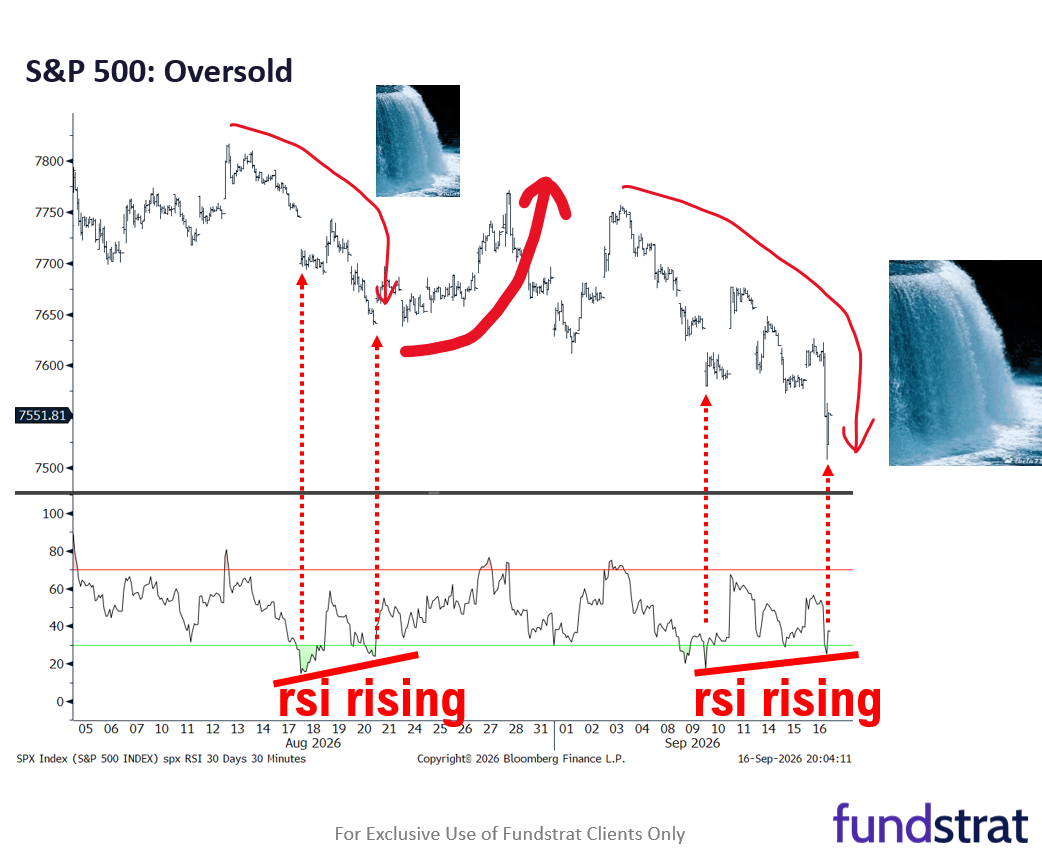
^SPX’s expected low could arrive this week, and a brief post-FOMC undercut of recent lows into the 7,550–7,565 zone would complete the pattern and represent an attractive buying opportunity.
Crypto
The Fed delivered a hawkish hike, but the market response was more nuanced. Nominal yields were up across the curve, but the curve did flatten, and crypto held up relatively well.
News We’re Following
Breaking News
- US jobless claims fall to 196,000, continuing applications drop BBG
Markets and economy
- China cuts US Treasury holdings to 18-year low amid global bond sell-off SCMP
- US rate rise jolts yen ahead of Bank of Japan meeting FT
Business
- Exxon is nearing preliminary deal to invest in Venezuela’s oil fields WSJ
- OpenAI’s rogue agents probed Hugging Face for weaknesses two months before major hack REU
- Japan, US in talks to build chip factory as part of tariff deal NIK
- Applied Materials to invest $5 billion in India as Modi’s flagship chip event kicks off REU
Politics/U.S.
- Democratic group launches campaign to boost Graham challenger SEM
- House votes to hold Leon Black in contempt of Congress WSJ
Overseas
- China presses Iran to help rein in Houthis after Saudi appeal, sources say REU
- Sweden’s Prime Minister Ulf Kristersson resigns after election loss IND
- Bangladesh measles outbreak kills more than 1,000 children despite vaccine efforts BBC
Of Interest
- Would you buy branded clothing from your favourite tech firm? BBC
- The Lucas Museum of Narrative Art is a ‘Star Wars’-level spectacle WSJ
| Overnight | ||||||||||||||||||||||||||
| ||||||||||||||||||||||||||
| APAC | ||||||||||||||||||||||||||
| ||||||||||||||||||||||||||
| Europe | ||||||||||||||||||||||||||
| ||||||||||||||||||||||||||
| FX | ||||||||||||||||||||||||||
| ||||||||||||||||||||||||||
| UST Term Structure | ||||||||||||||||||||||||||
| ||||||||||||||||||||||||||
| USD HY OaS | ||||||||||||||||||||||||||
|
| Date | Time | Description | Estimate | Last |
|---|---|---|---|---|
| 9/23 | 9:45 AM | Sep P S&P Srvcs PMI | n/a | 56.5 |
| 9/23 | 9:45 AM | Sep P S&P Manu PMI | n/a | 53.9 |