Choppy moves in global government bond yields dragged down stocks from records this week.
The S&P 500 slipped 1.4% to 7,674.37 points, posting its worst week since July 17. Tech stocks, in particular, were crushed, with the S&P 500’s information technology sector down 3.2%, while the Nasdaq composite declined 2.1%.
Even though stocks were already down to start the week, the losses accelerated after the 30-year Treasury yield hit its highest level in almost two decades. A similar story played out in Japan, Germany, the U.K., and France, where longer-dated bonds surged.
Then on Wednesday, the Treasury announced it would increase the size of its buyback operation for Treasury securities maturing in 10 to 20 years and 20 to 30 years, going from $2 billion to “at least” $4 billion. Though the strategy is pretty typical for the Treasury, its timing coinciding with the surge in yields sparked concerns among investors about the Federal Reserve’s independence because Chair Kevin Warsh wants to let the market participants independently set the yield without being influenced by the Fed.
While Treasury Secretary Scott Bessent’s strategy worked on the day of the announcement, the decline in yields faded by Thursday, even though that’s when he announced the buybacks could be higher than the $4 billion.
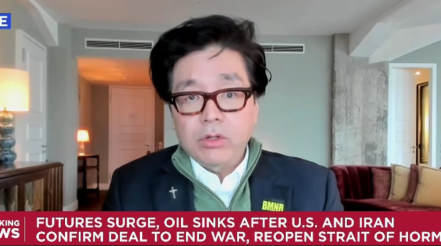
Fundstrat Head of Research Tom Lee says there’s at least three reasons for yields to be surging: (1) investors remain worried about the growing global deficit, which hit $40 trillion this week in the U.S. (2) oil disruption from Iran (3) hyperscaler capex keeps increasing.
Lee said stocks still remain in an uptrend, even if he projects that there will be a bear market later this fall.
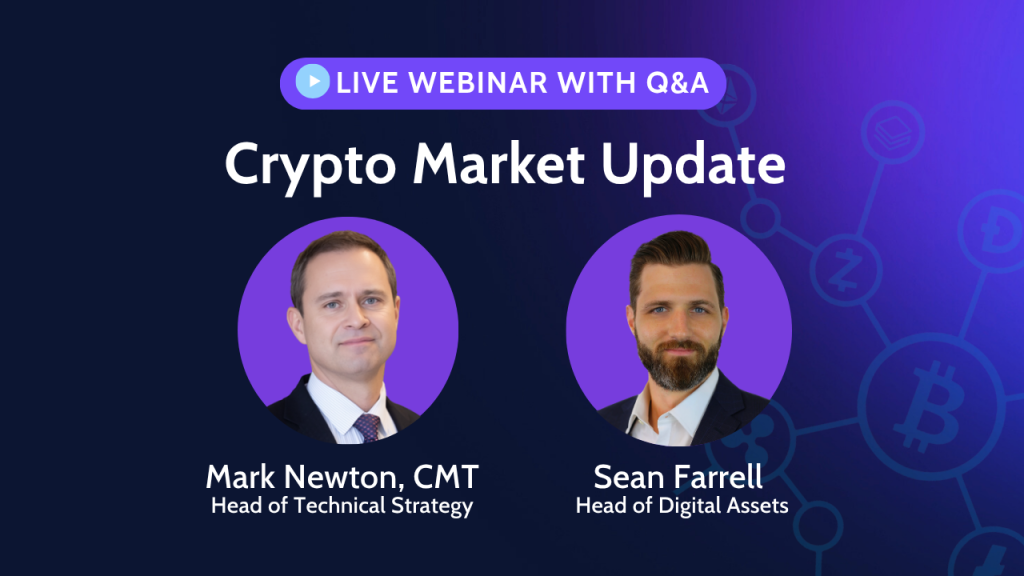
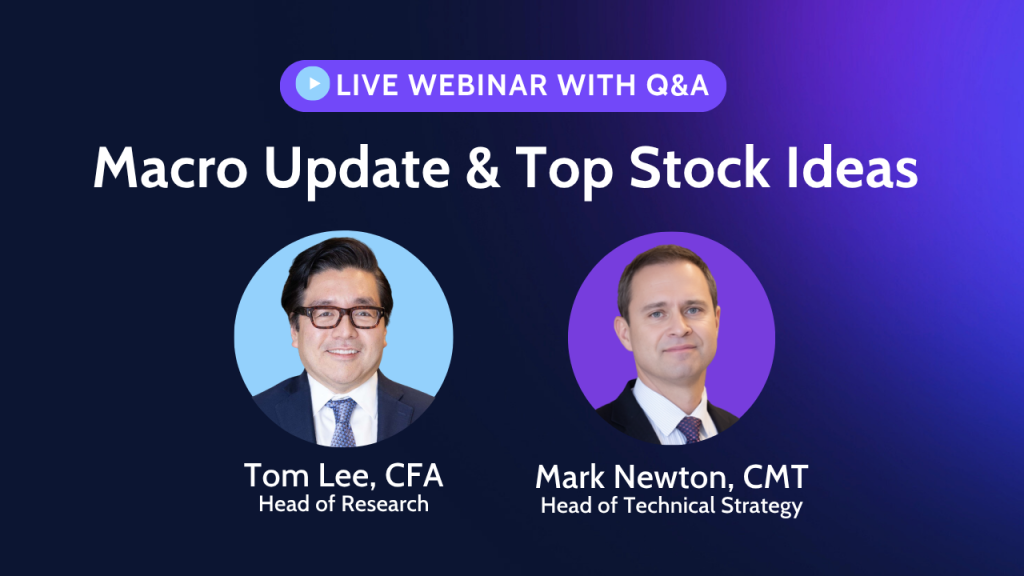
“Even if we think there is a speed bump later this year, we have not advised anyone to be selling because we just don’t know what level this correction could come from,” he said during the Macro Update & Top Ideas webinar. “If the S&P 500 goes to 8,200 between now and mid-September, then a 10% drawdown from 8,200 is different than a 10% drawdown from 7,700.”
Head of Technical Strategy Mark Newton has a slightly different take on how far stocks could fall later this year. He expects there to be a maximum of 5-7% decline between September and October or the midterms, partially because there’s been a big correction in tech already. “I think it’s going to be milder,” he said. “I’m actually more bullish than Tom between now and probably the midterms.”
Chart of the Week
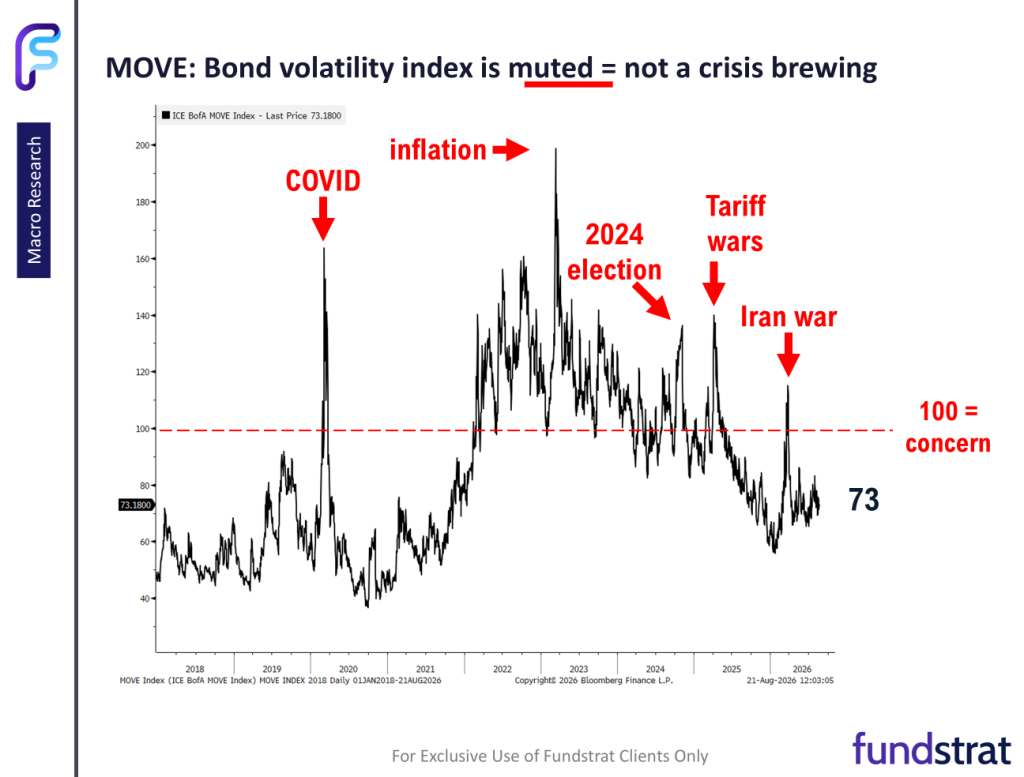
Fundstrat Head of Research Tom Lee isn’t too concerned about the recent rise in yields. He recommended those who are worried about a “crisis brewing” to look at Bank of America’s bond volatility index MOVE-4.88%. Currently, it’s slightly above 70. It was above 100 during Covid-19, inflation, 2024 election, tariff wars, and Iran war. “So I think the move in interest rates is interesting because it’s not pointing toward a crisis, but a natural rise in yields,” he said. “I don’t view this as a concern for stocks just yet until the MOVE index starts to move up.”
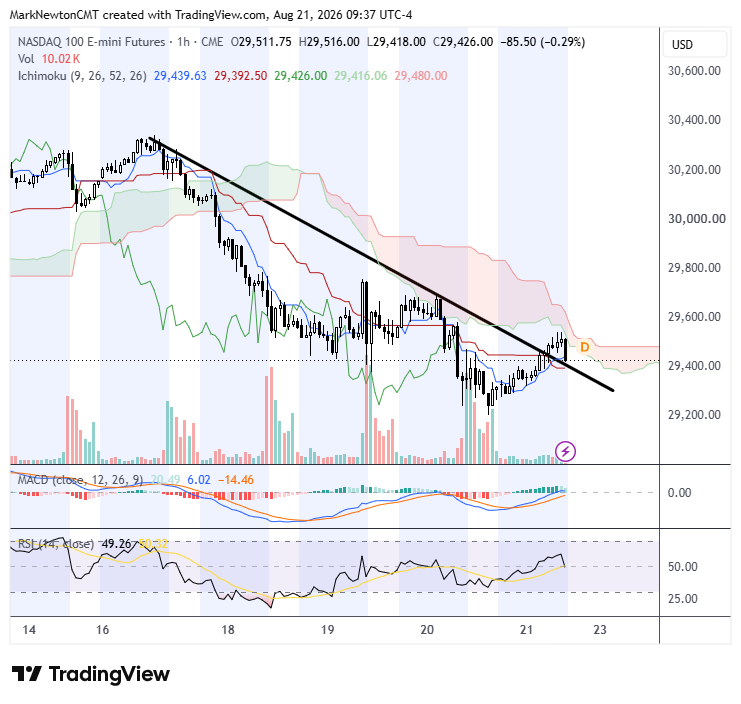
The early am boost for US Equity futures is partially being driven by Iran’s president saying it’s “better to end the war with dignity” Some might see this as a sign of de-escalation, but Pezeshkian has been notably one of the more vocal proponents of ending the war through diplomacy among Iranian officials. NASDAQ futures jumped up to its one-hour Ichimoku Cloud which often can cause resistance to price gains in the short run, similar what was seen yesterday on the bounce. As shown, despite the apparent minor breakout of this downtrend of the past week for NASDAQ, the Cloud looks to be holding this early bounce and prices are starting to backtrack. Key for NASDAQ futures are 29,202 and below this could lead to a final period of weakness down to 29132 or 28762, the 38.2% and 50% retracements of this push up from late July, but overall, prices are close to support and i do not expect much more weakness before prices start to turn higher. The risk/reward ahead of NVDA earnings next week is growing increasingly more favorable for Bulls
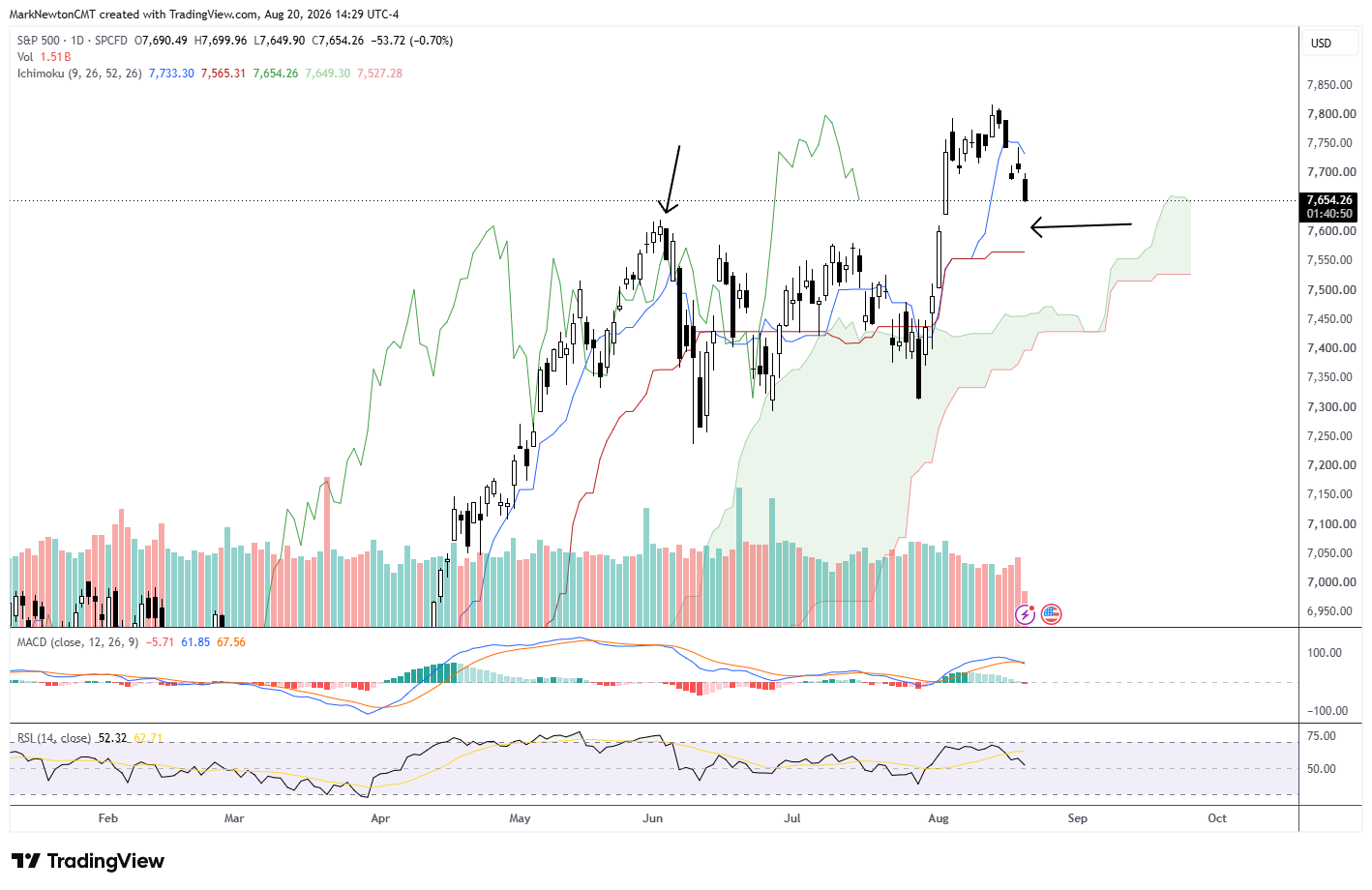
In the short run, the “1-2 combo” of Crude pushing up 3% along with US Treasury yields recouping yesterday’s drop and rallying is serving as a source of weakness for the US equity market, but for those with short-term views, ^SPX 0.40% is now approaching a very important area of support near 7625 which marked former peaks in early June and should result in some support for Equity indices on this weakness. Breadth is not overly negative at just under 2/1 negative and this remains a rather lackluster session. Overall, i see a good likelihood of SPX holding 7600-25 and for QQQ to hold 701 on weakness before snapping bac
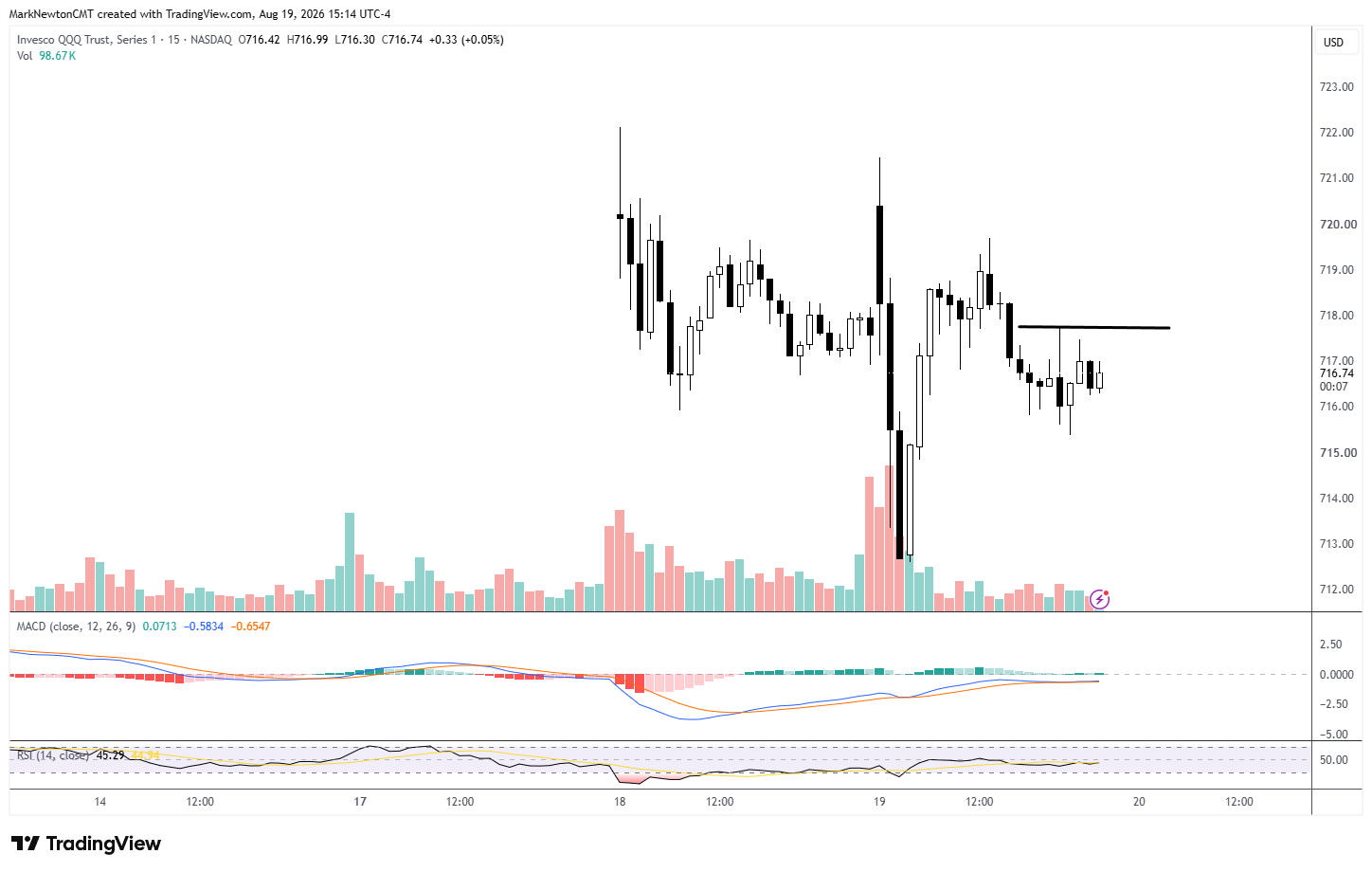
Following some consolidation in parts of Technology today which caused QQQ to lag the move in both SPX and DJIA today following the Treasury’s doubling of its buyback operations from 2 billion to 4 billion, there now looks to be an intra-day bottoming attempt from QQQ on hourly charts. As one can see, we’ve seen a minor ABC type formation after the initial lift and any push back above last hours highs of 717.77 would result in some strengthening into the close which likely could follow through tomorrow. Above 717.77 lies 719.70 followed by yesterday’s intra-day highs of 722.13. It goes without saying that closing well up off the lows would be technically better for daily technicals and my expectation is that a reversal back higher should help QQQ follow SPX and RSP and DJIA back to new highs into the Jackson Hole meeting on the Treasury’s liquidity easing measures.
This research is for the clients of Fundstrat Direct only. Fundstrat Direct Subscription entitles the subscriber to 1 user, research cannot be shared or redistributed. For additional information, please contact your sales representative or Fundstrat Direct at fundstratdirect.com.
Conflicts of Interest
This research contains the views, opinions and recommendations of Fundstrat Direct. At the time of publication of this report, Fundstrat Direct does not know of, or have reason to know of any material conflicts of interest.
General Disclosures
Fundstrat Direct is an independent research company and is not a registered investment advisor and is not acting as a broker dealer under any federal or state securities laws.
Fundstrat Direct is a member of IRC Securities’ Research Prime Services Platform. IRC Securities is a FINRA registered broker-dealer that is focused on supporting the independent research industry. Certain personnel of Fundstrat Direct (i.e. Research Analysts) are registered representatives of IRC Securities, a FINRA member firm registered as a broker-dealer with the Securities and Exchange Commission and certain state securities regulators. As registered representatives and independent contractors of IRC Securities, such personnel may receive commissions paid to or shared with IRC Securities for transactions placed by Fundstrat Direct clients directly with IRC Securities or with securities firms that may share commissions with IRC Securities in accordance with applicable SEC and FINRA requirements. IRC Securities does not distribute the research of Fundstrat Direct, which is available to select institutional clients that have engaged Fundstrat Direct.
As registered representatives of IRC Securities our analysts must follow IRC Securities’ Written Supervisory Procedures. Notable compliance policies include (1) prohibition of insider trading or the facilitation thereof, (2) maintaining client confidentiality, (3) archival of electronic communications, and (4) appropriate use of electronic communications, amongst other compliance related policies.
Fundstrat Direct does not have the same conflicts that traditional sell-side research organizations have because Fundstrat Direct (1) does not conduct any investment banking activities, and (2) does not manage any investment funds.
This communication is issued by Fundstrat Direct and/or affiliates of Fundstrat Direct. This is not a personal recommendation, nor an offer to buy or sell nor a solicitation to buy or sell any securities, investment products or other financial instruments or services. This material is distributed for general informational and educational purposes only and is not intended to constitute legal, tax, accounting or investment advice.
The statements in this document shall not be considered as an objective or independent explanation of the matters. Please note that this document (a) has not been prepared in accordance with legal requirements designed to promote the independence of investment research, and (b) is not subject to any prohibition on dealing ahead of the dissemination or publication of investment research.
Intended for recipient only and not for further distribution without the consent of Fundstrat Direct.
This research is for the clients of Fundstrat Direct only. Additional information is available upon request. Information has been obtained from sources believed to be reliable, but Fundstrat Direct does not warrant its completeness or accuracy except with respect to any disclosures relative to Fundstrat Direct and the analyst’s involvement (if any) with any of the subject companies of the research. All pricing is as of the market close for the securities discussed, unless otherwise stated. Opinions and estimates constitute our judgment as of the date of this material and are subject to change without notice. Past performance is not indicative of future results. This material is not intended as an offer or solicitation for the purchase or sale of any financial instrument. The opinions and recommendations herein do not take into account individual client circumstances, risk tolerance, objectives, or needs and are not intended as recommendations of particular securities, financial instruments or strategies. The recipient of this report must make its own independent decision regarding any securities or financial instruments mentioned herein. Except in circumstances where Fundstrat Direct expressly agrees otherwise in writing, Fundstrat Direct is not acting as a municipal advisor and the opinions or views contained herein are not intended to be, and do not constitute, advice, including within the meaning of Section 15B of the Securities Exchange Act of 1934. All research reports are disseminated and available to all clients simultaneously through electronic publication to our internal client website, fundstratdirect.com. Not all research content is redistributed to our clients or made available to third-party aggregators or the media. Please contact your sales representative if you would like to receive any of our research publications.