The Federal Reserve raising interest rates for the first time since 2023 and indicating further hikes to come further dragged away stocks from their records, even though the move was largely priced in.
The S&P 500 notched a tiny 0.09% decline this week, despite eight out of the 11 sectors ending in the red. Only health care, technology, and communication services were in the green. The broad-based index is now off 2.1% from its all-time highs. The tech-heavy Nasdaq composite fared slightly better, up 0.72% this week, but there wasn’t any specific news behind why that was so. Bullish options bets in AI names, possibly by just one buyer, could be providing a boost.
Fundstrat Head of Research Tom Lee still stands by his view that this will be a “Sup”-tember, and he continues to expect the rally to be a face-ripper. That’s because fundamentals remain solid, investor sentiment remains cautious, and a waterfall decline, such as the one seen this past week, is usually followed by a rally. More importantly, incremental data, in his view, will be dovish, which could further culminate in gains. Currently, the index is down 0.46% this month.
Most of the pain this week came on Wednesday, after the Federal Open Market Committee voted unanimously for a 25 basis-point hike to take rates in the range of 3.75%-4%. As it turns out, it’s also not a one-and-done deal because the Fed penciled in at least another hike later this year.
On Sept. 30, the core personal-consumption expenditures report will be published under the new methodology, which hopefully gets rid of the distortion from higher memory and storage prices. Lee said that the Summary of Economic Projections doesn’t seem to have incorporated these well telegraphed changes in the core PCE inflation projection of 3.4% this year.
To him, “equity and bond investors are arguably over-reacting.” But still, as Lee has noted in recent weeks, there’s methodological reasons for the difference between the CPI and PCE, and if the latter converges to CPI in coming months, then “tightening today is a mistake.”
Head of Technical Strategy Mark Newton says on a technical basis U.S. stocks remain in “good shape” despite the dual threat of higher interest rates and oil prices in recent days. Long-term breadth also remains decent, with the Russell 3000’s percentage of stocks above their 200-day moving average—a widely followed technical indicator— above 50%. (He added that most of the breadth damage is concentrated in defensive sectors like utilities, real estate, along with industrials and consumer discretionary.)
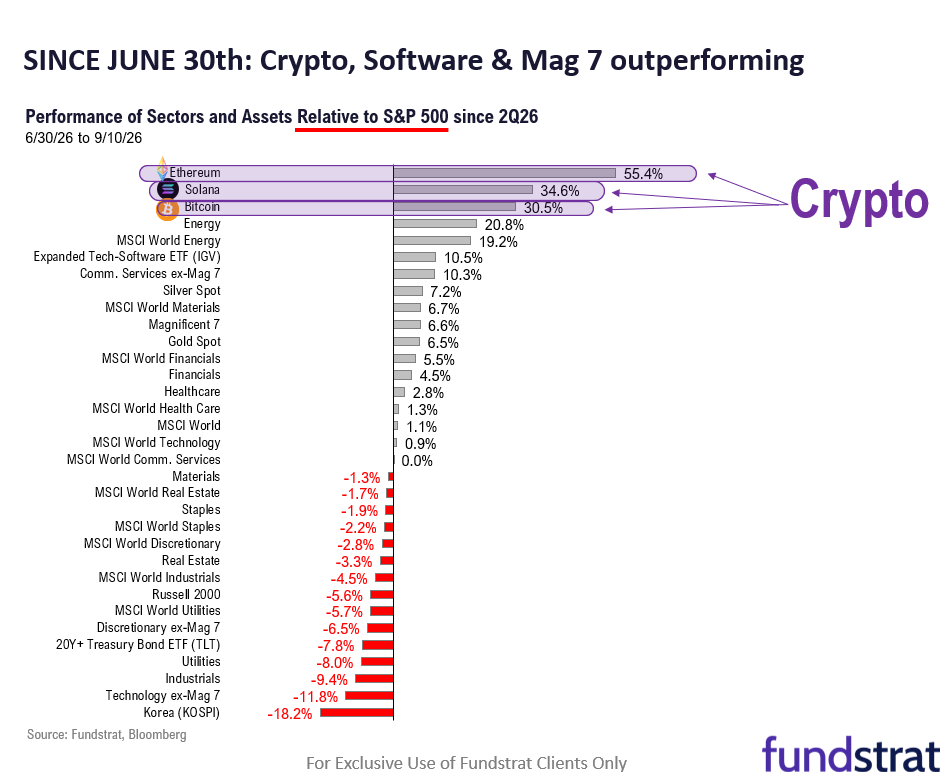
Chart of the Week
Fundstrat Head of Research Tom Lee believes that in the coming week, Fed governors will walk back on the “max hawkish” words of Warsh. He likes crypto, highlighting that ethereum remains the best performing major macro asset in the third quarter, as our Chart of the Week shows.
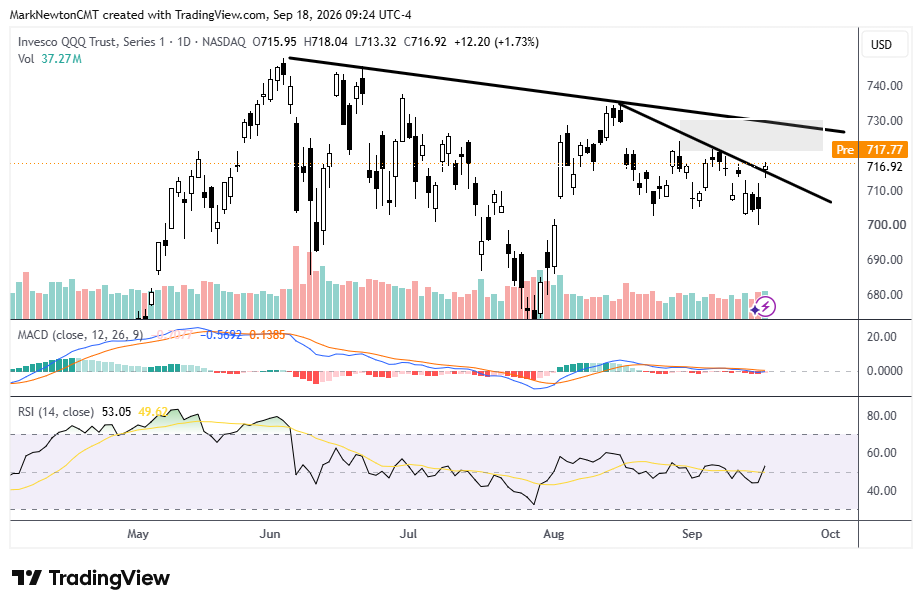
If what I’m thinking is correct, this first bounce off the lows could face resistance into late today/early Monday before some “Backing and filling” which takes place during next week which is widely known to be the most seasonally bearish week of September. i do feel that this week marked a low to this pullback from mid-August, but given the choppy nature of the recent rotation coupled with ongoing weakness in Treasuries (^TNX 1.03% is back to levels near where Scott Bessent announced the bond buyback) i suspect some choppiness should be expected. Near-term, QQQ 0.70% showed a minor breakout as of last night’s close and could extend to 721, while the larger “line in the sand” lies near 728 of this entire triangle consolidation. Thereafter, some minor consolidation could be possible ahead of my expectations of a big push up into mid-to-late October for US indices. For many who aren’t short-term focused, being long and simply buying dips makes sense. Overall, a good technical move this week in many US indices, but potentially next week might not be the ideal week for the upside acceleration, if seasonality is any guide.
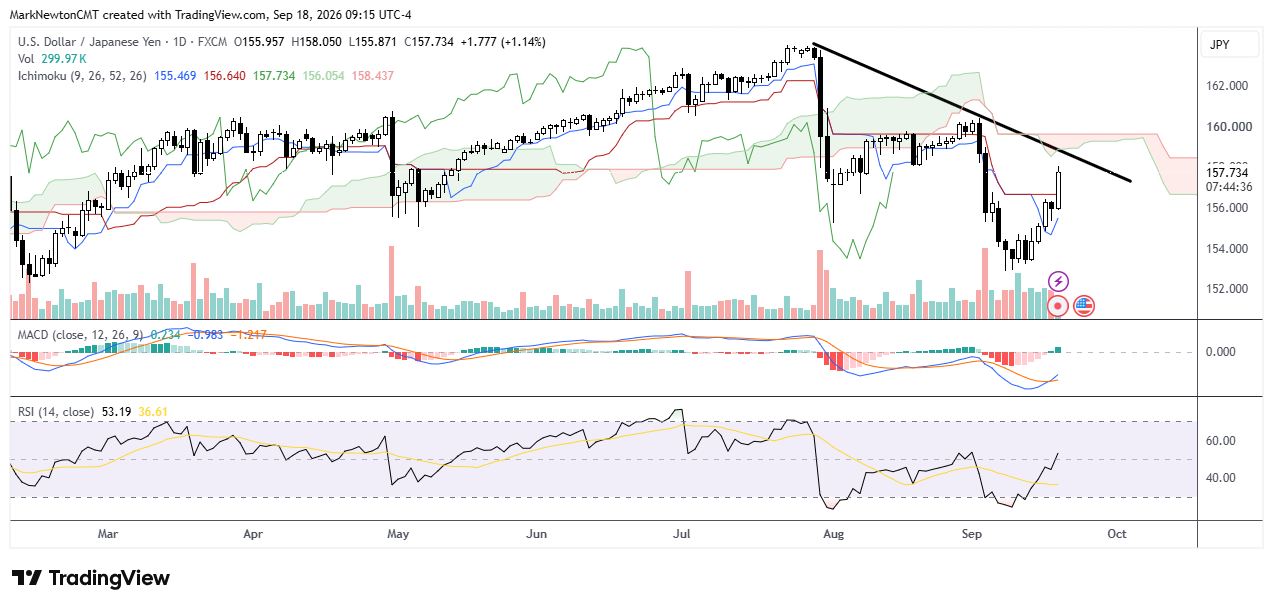
Following the 25 bp hike for BOJ last night, in a nod to Scott Bessent, PM Ueda said “Stage for Policy Conduct has changed” However, given the 2 dissenting votes on the rate hike, USDJPY turned back sharply higher and the chances for an October hike have decreased to just 20%. The JGB yield curve is steepening, unlike what’s been happening across the globe as US 10’s-2’s curve fell to 19 month lows. My thinking is that additional gains in both USDJPY along with DXY are likely into October before resuming a decline. Technically speaking, while some minor resistance looks likely near 159, pullbacks could prove short-lived at the moment before even more Yen weakness which might take this higher to 160 vs. the US Dollar. Thereafter, it’s right to expect another retest of this month’s lows, which might happen if US steps in to help with intervention efforts. Overall, i don’t suspect USDJPY will get much under 150 before beginning another leg higher in Q4 as the preference for gradualism looks clear.
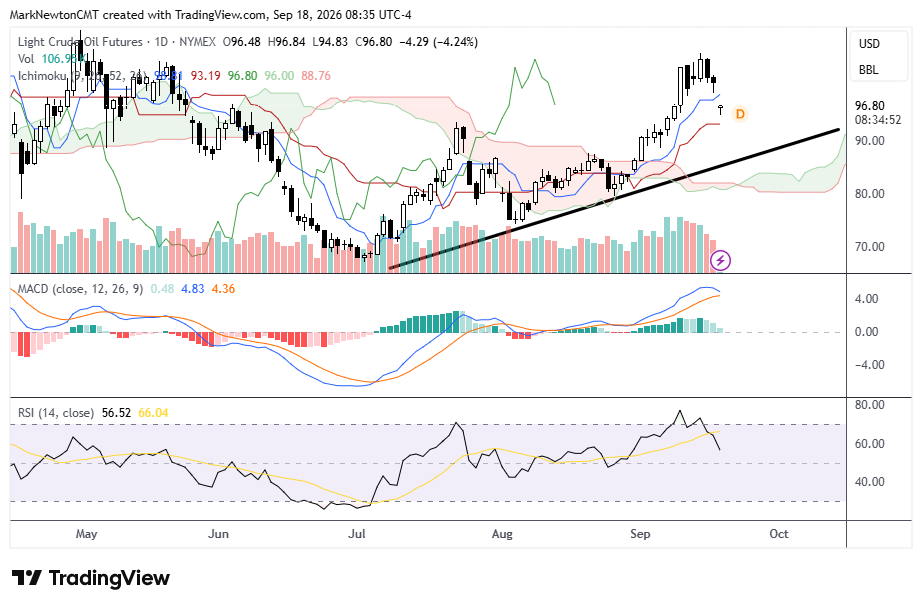
The selloff in WTI Crude has continued this week, with continuous Crude contracts lower by another 4%, but largely based on reduction in geopolitical risk premium than any real normalization in the supply/demand picture, but given the Saudi resumption of more Oil in the Hormuz Strait along with the reopening of the East-West Pipeline, WTI Crude has fallen a bit more than 10% in the last three trading sessions. Technically speaking, prices are nearing initial support, and my view is the likely trajectory calls for some stabilization in price along with a mild bounce followed by a resumption of the decline in the near-term into October which should see Crude fall to the high $80’s/Low $90’s before a rally in October. Bottom line, this looks to be a short-term correction only, not the start of a more meaningful decline. Thereafter, i expect Crude pushes back to new highs for 2026, which means any larger peace resolution still might prove premature to expect.
This research is for the clients of Fundstrat Direct only. Fundstrat Direct Subscription entitles the subscriber to 1 user, research cannot be shared or redistributed. For additional information, please contact your sales representative or Fundstrat Direct at fundstratdirect.com.
Conflicts of Interest
This research contains the views, opinions and recommendations of Fundstrat Direct. At the time of publication of this report, Fundstrat Direct does not know of, or have reason to know of any material conflicts of interest.
General Disclosures
Fundstrat Direct is an independent research company and is not a registered investment advisor and is not acting as a broker dealer under any federal or state securities laws.
Fundstrat Direct is a member of IRC Securities’ Research Prime Services Platform. IRC Securities is a FINRA registered broker-dealer that is focused on supporting the independent research industry. Certain personnel of Fundstrat Direct (i.e. Research Analysts) are registered representatives of IRC Securities, a FINRA member firm registered as a broker-dealer with the Securities and Exchange Commission and certain state securities regulators. As registered representatives and independent contractors of IRC Securities, such personnel may receive commissions paid to or shared with IRC Securities for transactions placed by Fundstrat Direct clients directly with IRC Securities or with securities firms that may share commissions with IRC Securities in accordance with applicable SEC and FINRA requirements. IRC Securities does not distribute the research of Fundstrat Direct, which is available to select institutional clients that have engaged Fundstrat Direct.
As registered representatives of IRC Securities our analysts must follow IRC Securities’ Written Supervisory Procedures. Notable compliance policies include (1) prohibition of insider trading or the facilitation thereof, (2) maintaining client confidentiality, (3) archival of electronic communications, and (4) appropriate use of electronic communications, amongst other compliance related policies.
Fundstrat Direct does not have the same conflicts that traditional sell-side research organizations have because Fundstrat Direct (1) does not conduct any investment banking activities, and (2) does not manage any investment funds.
This communication is issued by Fundstrat Direct and/or affiliates of Fundstrat Direct. This is not a personal recommendation, nor an offer to buy or sell nor a solicitation to buy or sell any securities, investment products or other financial instruments or services. This material is distributed for general informational and educational purposes only and is not intended to constitute legal, tax, accounting or investment advice.
The statements in this document shall not be considered as an objective or independent explanation of the matters. Please note that this document (a) has not been prepared in accordance with legal requirements designed to promote the independence of investment research, and (b) is not subject to any prohibition on dealing ahead of the dissemination or publication of investment research.
Intended for recipient only and not for further distribution without the consent of Fundstrat Direct.
This research is for the clients of Fundstrat Direct only. Additional information is available upon request. Information has been obtained from sources believed to be reliable, but Fundstrat Direct does not warrant its completeness or accuracy except with respect to any disclosures relative to Fundstrat Direct and the analyst’s involvement (if any) with any of the subject companies of the research. All pricing is as of the market close for the securities discussed, unless otherwise stated. Opinions and estimates constitute our judgment as of the date of this material and are subject to change without notice. Past performance is not indicative of future results. This material is not intended as an offer or solicitation for the purchase or sale of any financial instrument. The opinions and recommendations herein do not take into account individual client circumstances, risk tolerance, objectives, or needs and are not intended as recommendations of particular securities, financial instruments or strategies. The recipient of this report must make its own independent decision regarding any securities or financial instruments mentioned herein. Except in circumstances where Fundstrat Direct expressly agrees otherwise in writing, Fundstrat Direct is not acting as a municipal advisor and the opinions or views contained herein are not intended to be, and do not constitute, advice, including within the meaning of Section 15B of the Securities Exchange Act of 1934. All research reports are disseminated and available to all clients simultaneously through electronic publication to our internal client website, fundstratdirect.com. Not all research content is redistributed to our clients or made available to third-party aggregators or the media. Please contact your sales representative if you would like to receive any of our research publications.