


Stocks Continue Slide, AI Trade Evolves

Our Views

- We understand why it feels like a bear market out there. The story of “software eating the world,” which we read repeatedly from 1980-2025, is now becoming one of “AI eating software.” When this is paired alongside rotation within the AI trade (from the Magnificent Seven to companies in processors, chips, energy, and infrastructure) it likely makes markets feel quite turbulent. While we are cognizant of this thematic ballast shifting, we do not think we should necessarily “underweight” the Mag7. They are all tied to the same theme, in our view.
- In our view, the carnage in software is evidence that AI is productive and has a payoff. To us, it argues that AI’s biggest impact in the US is ultimately less inflation. Because if there are fewer workers, less software and services spend, but the same output, this is both productivity-enhancing and disinflationary.
- We continue to view 2026 as an overall tougher year for markets, with a 3 phase market (rally, then large decline, then YE strong).

- Trends for equities remain upward sloping based on equal-weighted SPX, but the underlying volatility across equities has picked up measurably despite no true underlying trend in SPX since last October’s close.
- It’s difficult for me to consider that trends are changing, barring an actual breakdown in intermediate-term price trends and breadth gauges (which hasn’t happened). However, I see a plethora of advance warning signs that are starting to crop up, which are important to pay attention to at this stage of the rally.
- Overall, I am expecting a choppy push higher up to the 7100-7200 area, but feel like the upside should be limited to around 3% higher. Meanwhile, any drop under early February lows at 6780.13 would serve to turn trends negative, and this remains arguably the “line in the sand” for trend followers.

- Jobs data surprised to the upside, pushing yields higher and pricing out near-term Fed cuts, which contributed to sideways risk asset performance and muted crypto follow-through. On the other hand, CPI came in cooler than expected, which is welcome news for crypto.
- We have seen what I view as fairly “Goldilocks” data over the last few days. Crypto has held up well and continues to gain on a relative basis versus equities. It is still early, but the resilience is encouraging. I suspect the relative strength is being driven by DAT buying (MSTR briefly traded up to ~1.2x mNAV this week) and some degree of seller exhaustion.
- Yen strength is a marginal headwind for global liquidity, as carry unwinds can pressure risk assets, something to monitor but not yet a major concern.
- Bitcoin continues to trade more like a growth asset than digital gold, tracking equity style rotations and risk sentiment rather than pure store-of-value flow

- Funding for the Department of Homeland Security will expire tonight at midnight, and Congress has already left town for a 10-day holiday, making immediate resolution unlikely.
- It’s unclear how this affects ICE funding as the One Big Beautiful Bill Act provided the agency with additional funding, but other DHS departments providing key services, such as the TSA, will be affected.
- Meanwhile, a dispute over Fed independence continues to stand in the way of confirmation for President Trump’s nominee for Federal Reserve Chair, Kevin Warsh, with a key Senate Republican blocking the process.
Wall Street Debrief — Weekly Roundup
Key Takeaways
- The S&P 500 closed the week at 6,836.17, down 1.39%, while the Nasdaq Composite declined 2.10% to 22,546.67. Bitcoin was at USD $68,933.97 on Friday afternoon, down about 1.95% from Monday levels.
- Fundstrat Head of Research Tom Lee sees the current rotation within the AI trade as strikingly similar to market precedents during the nationwide building of wireless telecom networks in the late 1990s and 2000s, with the constructive thesis intact.
- Head of Technical Strategy Mark Newton reminded us that two separate historical precedents suggest the likelihood of a challenging year for investors this year.
"Gray skies are just clouds passing over." – Duke Ellington
Good evening,
The S&P 500 slipped 1.39% this week, and the Nasdaq Composite fell still further, ending the week down 2.10%. Software stocks helped lead the indexes lower, as worries over whether AI would render many forms of software redundant maintained their presence on investors' wall of worry. As Fundstrat Head of Research Tom Lee put it, the story of "software eating the world," which we read repeatedly from 1980-2025, is now becoming one of "AI eating software."
From a technical analysis perspective, Head of Technical Strategy Mark Newton acknowledged that "software has struggled to stabilize and find a bottom, [and] they look like they're going straight down in the short run." Going forward, Newton told us that "I don't sense it's going to be an area to overweight within technology."
As he told us during our weekly huddle, however, the situation does not necessarily look so dire for those with more of an intermediate-term timeframe. "The intermediate-term charts help to put this deterioration into perspective," he suggested, and "I do sense that this group can bounce."
Yet Lee views the current mood of the market as also related to the current rotation within the AI trade, away from the Magnificent Seven and toward companies in processors, chips, energy, and infrastructure. "This can make markets feel quite turbulent," Lee noted. Taking a look at market history, Lee sees a similarity between the current scenario and the situation with the initial building of nationwide wireless networks in the 1990s and early 2000s. In those days, investor appetite shifted between buying carriers and buying infrastructure and handset makers. "Back then, we'd call this 'buying the armies or buying the bullets,'" he told us. In a modern context, the current AI activity can be seen similarly, as investors shift behind the Magnificent Seven (the "armies") and those companies that make "bullets" – processor and memory-chip makers and those in the business of building out data centers, such as energy companies and related equipment makers. This dichotomy is illustrated in our Chart of the Week:
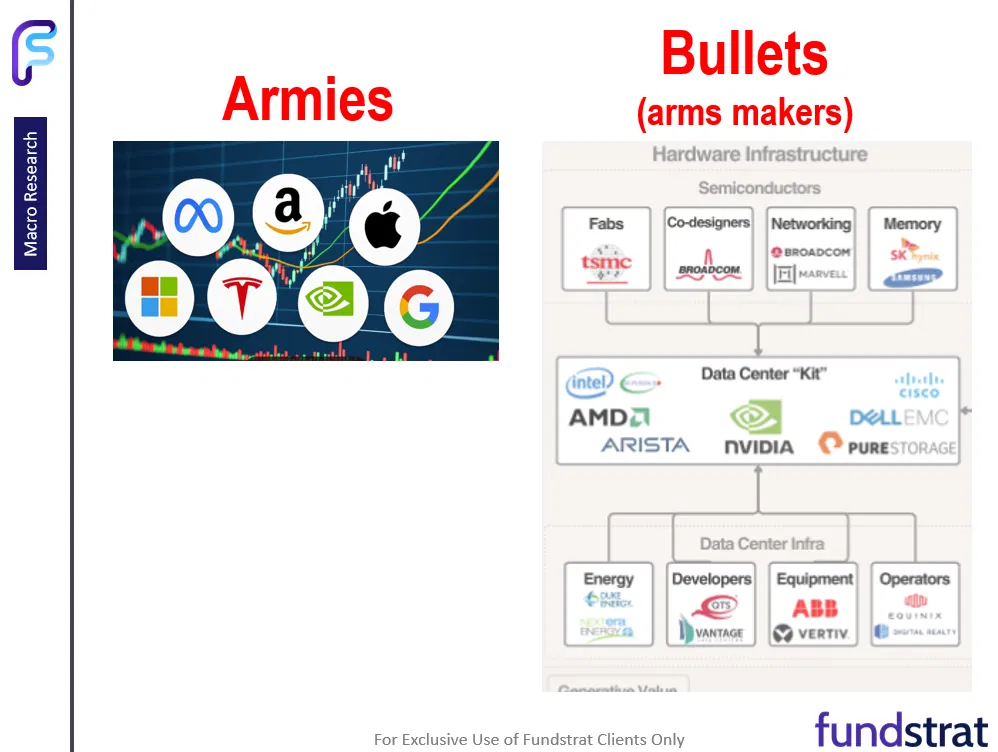
This arguably explains the current outperformance of energy/basic materials, commodities, industrials, memory, chipmakers," Lee said, but it does not necessarily mean underweighting or divesting from the "armies" of the Magnificent Seven, in his view. "At some point, this rotation will arguably shift again to Mag7," he told us.
The longer view
Regardless of one's views on Kevin Warsh, President Trump's choice to succeed Jerome Powell as chair of the Federal Reserve, Newton noted that the changeover to a new Fed chair has historically tended to be followed by market uncertainty and short-term drawdowns. "The market's going to need an adjustment period to get used to the [new] Fed-speak," he pointed out, noting that "we have absolutely no idea what [Warsh's] communication style will be compared to Powell." (Warsh is still in the early stages of the confirmation process.)
Newton also sees a seasonality challenge. "The second year of a second term of a president has tended to coincide with challenging years for stock investors," he pointed out, a pattern that has largely held true going as far back as Harry S. Truman's second term.
This year, Newton expects the pattern to continue. Looking at the area around 7,150 for the S&P 500, Newton told us, "I don't think S&P is going to get above here for at least the spring. So I think that we have one final push that's going to happen over the next couple of weeks and it's going to be right to sell into that."
For the most part, this independently coincides with Lee's view. As he reiterated this week, Lee said, "We still think markets have enough tailwinds to get to 7,300, and then do think there's a drawdown that feels like a bear market this year. And then year-end we do finish stronger, in my view."
Sector Allocation Strategy
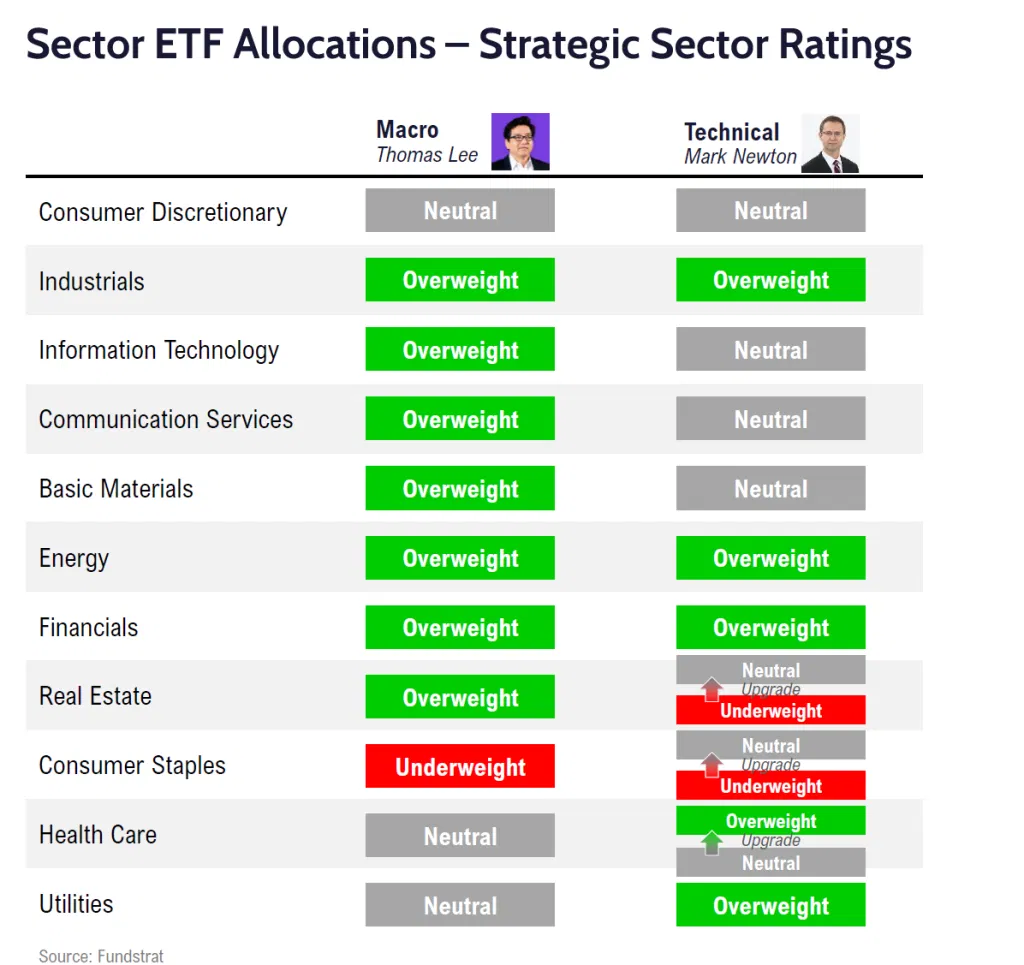
These are the latest strategic sector ratings from Head of Research Tom Lee and Head of Technical Strategy Mark Newton – part of the February 2026 update to the FSI Sector Allocation Strategy. FS Insight Macro and Pro subscribers can click here for ETF recommendations, precise guidance on strategic and tactical weightings, detailed commentary, and methodology.
Elsewhere
Alphabet issued a century bond – a bond with a term of 100 years. The Alphabet bond offers a 6.125% yield and is part of a larger fundraising effort that will be used to further advance the Google parent's buildout of data centers and related energy efforts. Demand was high for the bond, and the offering was massively oversubscribed.
A federal grand jury rejected prosecutors' request to indict Democrats who produced and circulated a video reminding military servicemembers of their legal obligation to refuse to obey "manifestly illegal" orders. (It is not clear what charges the prosecutor, Jeanine Pirro, sought to bring.) The Trump administration has criticized the Democrats, including Sen. Mark Kelly of Arizona and Rep. Elissa Slotkin of Michigan for accurately citing a fundamental, longstanding tenet of the Uniform Code of Military Justice that governs all U.S. servicemembers. The president asserted that the reminder undermines the president's authority as commander in chief, encourages disorder and disobedience, and could amount to sedition.
Kraft Heinz said it would suspend plans to split the two formerly independent companies, with new chief executive Steve Cahillane viewing the problems arising from the troubled merger of the two food conglomerates as fixable and worth the attempt. The split was announced in September, and the merger took place in 2015.
Abigail "Gail" Slater has been forced to step down as head of antitrust efforts for the Department of Justice. Slater, who had been championed by Vice President JD Vance, fell out of favor after a series of clashes with her direct boss, Attorney General Pam Bondi, generally as Slater pursued a less-business-friendly, more skeptical approach to reviewing proposed mergers than many in the Trump administration would have preferred. Omeed Assefi, who served as deputy under Slater, has been named acting head of the division.
The YouTube star known as Mr. Beast bought Step, a youth-focused financial services app, marking an expansion for his company, Beast Industries, beyond gaming and snacks. Mr. Beast, also known as Jimmy Donaldson, originally won fame and fortune with endurance-challenge and stunt videos on the streaming platform. Step, whose backers include Stripe, provides banking and investing services for young users (despite not being a bank itself).
Canada is in shock and mourning after one of the worst mass shootings in its history. Nine people, including the shooter, were killed in the tiny town of Tumbler Ridge, in the western province of British Columbia. The victims also include five children aged 12-13 and one teacher. Also found dead at the shooter's home were his mother and 11-year-old stepbrother. At least 27 others were wounded.
North Korea's Kim Jong Un has picked his daughter Kim Ju Ae as his heir-apparent, according to South Korea's intelligence agency. Little is known about the younger Kim, who is believed to be in her early teens, but she has reportedly started to provide policy input and has frequently been seen beside her father in public.
And finally: The U.S. fell to its lowest-ever position in the Transparency International's Corruption Perceptions Index, a widely accepted measure of global corruption. The U.S. ranked 29th out of 182 in the latest rating, tied with the Bahamas. The United Kingdom also fell to its lowest-ever rank, 20th. At the top of the list (perceived as the least corrupt) were Denmark, Finland, and Singapore. The bottom (perceived as most corrupt) features South Sudan and Somalia (tied), and Venezuela.
Important Events
Prev.: 37
Est.: 0.3% Prev.: 0.2%
Prev.: 52.4
Est.: 735K