


Nasdaq Composite Enters Correction Territory

Our Views

- The policy shock is the blue tsunami “shock” as incoming Congress won on an “Anti-AI” platform. Many incoming governors and Congress members spoke of the need for moratoriums on AI data centers and the prevention of super intelligence.
- The visibility shock is investors worry about the future roadmap for data centers and overall drivers for AI. This reminds of how investors panicked on semis and Nvidia after DeepSeek’s release of the far reduced computational needs.
- As for the liquidity shock, there are multiple stories of hedge fund closing portfolios and other liquidations. The surge in the VIX and the sizable moves in many AI/tech names gives a lot of credibility to this happening.
- More importantly, we believe the AI structural story is intact. The ‘blue tsunami’ while interrupting the narrative, in our view, is not an AI killer.

- While I had suspected cyclical weakness might materialize after a bounce into mid-month, this immediate selling pressure likely means this is already underway and now should attempt to bottom out by mid-month.
- Given that markets are now in November, when mean-reversion-type strategies start to take hold and investors look to overweight the laggards and underweight the leaders, my expectation is that it’s right to own Tech between now and next year, and despite the volatility, I do not sense this is a time to abandon this sector.
- Overall, I remain Overweight Technology, and while this decline has proven severe, I don’t sense this pullback is different from what was seen this past summer or spring.
- Sectors like Utilities and Staples, which have rallied over 8% in the last month, are not likely going to be able to continue showing outperformance, particularly if interest rates start to tick back higher.

- Thursday was a genuinely violent day across risk markets, and crypto was finally pulled into the broader tech selloff. BTC had held up remarkably well through much of the recent weakness in technology, but that resilience broke down today as selling broadened across asset classes and correlations moved sharply higher.
- I think the initial catalyst still traces back to the concerns we have been discussing around the AI infrastructure buildout. The election increased uncertainty around the extent to which new data-center projects could face permitting delays, moratoriums, audits, or other restrictions, particularly following the gubernatorial result in Texas. Less data-center capacity means fewer places to deploy chips, which can ultimately feed back into chip demand, hyperscaler capex expectations, and the broader tech complex. At the same time, questions around frontier-lab profitability and AI monetization remain unresolved, which only adds to the uncertainty around the buildout.
- The size and speed of the move were nevertheless unusual. Implied correlations rose sharply, while the S&P fell roughly 4% from a relatively subdued starting level for the VIX. Since 1990, we have never seen a comparable 4%+ S&P decline begin from a volatility backdrop this benign. That suggests positioning and forced deleveraging may have exacerbated the fundamental move.

- Congress returns next week, with the blue-wave results of the midterm elections likely to weigh on how to confront a looming Dec. 11 government-shutdown deadline.
- The Congress that convenes in January will see Democrats controlling the Senate, but not with enough of a majority to override a presidential veto or to stop a GOP filibuster.
- President Trump has worked with Democrats in New York City in his previous career, and this real-world experience could be useful in dealing with the next Congress.
Wall Street Debrief — Weekly Roundup
Key Takeaways
- The S&P 500 closed the week at 7,376.86, down 2.7%. The Nasdaq Composite fared worse, falling 3.4% to 24,579.42. Bitcoin was at USD 75,781.72 on Friday afternoon, down about 3.2% from Monday levels.
- Fundstrat Head of Research Tom Lee said that AI’s structural story remains intact, even if there are widespread data center moratoriums.
- Head of Technical Strategy Mark Newton said that he’s not yet convinced that tech stocks have capitulated.
"If you think about something at three o'clock in the morning and then again at noon the next day, you get different answers." — Snoopy
Good evening,
Chaos ensued in the stock market this week.
While worries over the midterm election outcome had already weighed over the market in recent weeks, it seems like it wasn’t all priced in. It wasn’t just a blue wave, it was a “blue tsunami,” as Fundstrat Head of Research Tom Lee put it.
Democrats won control of both the House and the Senate. It seemed like this was celebrated by investors on Wednesday, but the gains fizzled out by Thursday when the Nasdaq composite entered correction territory—defined as decline of 10% from a recent high. The tech-heavy index lost 3.4% this week, down to 24,579.42 points. The S&P 500 fared slightly better, closing out the week down 2.7% to 7,376.86 points. The broad-based index has declined for four weeks in a row for the first time since the weeks ending March 27.
As the artificial intelligence buildout was on many state and local ballots this November, investors are concerned that a Democratic sweep means that there will be a moratorium on data centers, which could hurt profits at hyperscalers and chip makers and the broader tech space. In typical fashion, investors had a knee-jerk reaction and sold anything with AI exposure.
Nvidia NVDA shares lost 8.8% this week, while Micron MU and Broadcom AVGO tumbled 22% and 9.9%, respectively.
The percentage of investors with bearish sentiment rose to 48.4% for the week ending Nov. 4 compared to 41.4% in the prior period, according to an American Association of Individual Investors’ survey.
Lee is in the other camp, reiterating this week that AI’s structural story remains intact.
He pointed to historical data, saying that when markets noted a sharp pullback, such as with 2025’s DeepSeek moment and then Liberation Day, followed by the Situational Awareness shock of 2026, “markets bottomed within days of that fierce and rapid decline.”
To Lee, this week reminded him of the Japanese word for crisis “ke-ke,” which is composed of two characters: danger and opportunity. Typically, investors tend to focus on the “danger” in a crisis and then later chase the “opportunity,” but he recommended investors to approach this sell-off as an opportunity.
“This moratorium on AI is not a demand story,” Lee said in Thursday’s Macro Minute video. “AI demand remains strong. It's driven by continued frontier innovation and actually productivity growth, and we're seeing it actually at the economic or macro level.”
He also addressed the supply side concerns. “The danger would be excess supply. AI is already in a tight market for semiconductors, memory, power, and infrastructure. If anything, this is going to tighten the supply market even further, and we already know GPU prices are going up. So, this is actually, in some ways, good for pricing,” he said.
The speed of deployment albeit could slow down, but to Lee, these worries are all just a “speed bump.” He pointed to how U.S. companies have successfully navigated multiple tests in the past five years, such as the Covid-19 shock, supply chain chaos, surging inflation in 2022, fastest interest-rate hikes in decades, tariffs, and then the energy fallout from the war in Iran this year. He has confidence that corporations will respond dynamically to this shock, too.
“I don't think the blue tsunami is going to end the ability of U.S. companies to grow earnings and build AI data centers,” he said. “In fact, we already see some ingenuity at work. Nvidia's retrofitting some old phone buildings to build data centers. And of course, they may just move overseas because data centers will have to get built somewhere.”
Lee also remains bullish on tech because the Nasdaq 100’s daily RSI shows that it's oversold, and it’s also oversold relative to its 200-day moving average. Our Chart of the Day has more details:
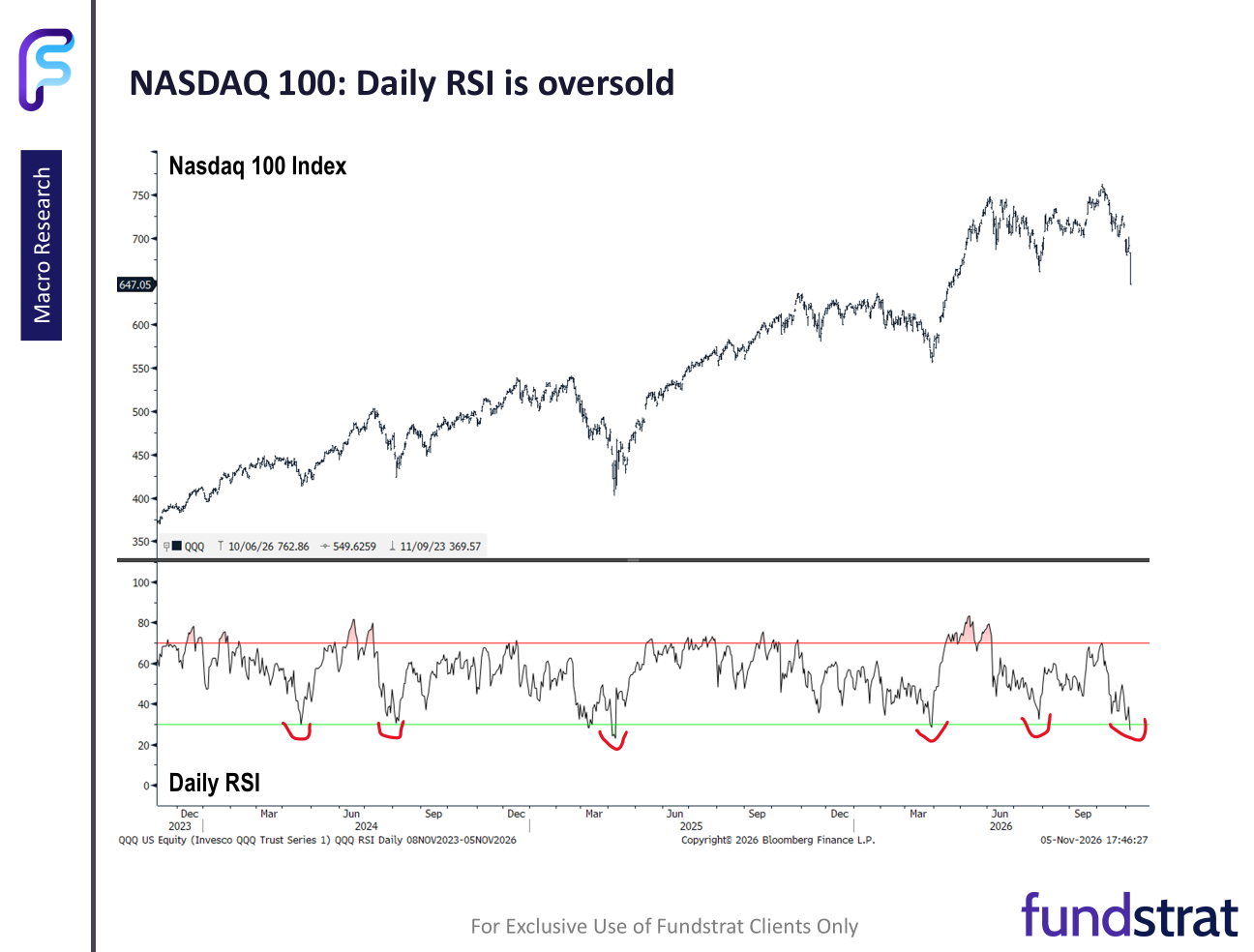
“As painful as it sounds, I think that this is a dip-buying opportunity, not the start of a big decline in AI,” he said.
Head of Technical Strategy Mark Newton has similar views. He said that the period after elections and until the next Monday is particularly volatile in cycles like these. The equal-weight S&P 500, which gives equal importance to small and large companies, has added 1.7% in the last month, outperforming its cap-weighted peer’s 5.7% loss.
“Certainly over the last couple of weeks, we've seen one of the biggest bifurcations in the market in a long time,” he said during the weekly huddle.
He still recommends the healthcare sector, and continues to rank tech as overweight, even if he isn’t convinced that the capitulation is here.
“It's just that technology in the short run is going straight down and it's difficult to find a floor, so that makes it feel like we're in this big bear market,” he said.
He expects the next few weeks to be very choppy because it doesn’t seem like tech stocks have bottomed yet. However, his technical work shows that it’s right to be long the S&P 500 between now and the next six months.
Outside of AI, market forces seem to be working in favor of the economy. Oil prices dropped 14% this week to below $100 a barrel. The 10-year Treasury yield fell to 4.858% this week, with bets on a December interest-rate hike receding. The October jobs market report looked strong, as well, with the economy gaining 165,000 jobs, above the estimate of 59,000. The unemployment rate, meanwhile, edged down to 4.1% from 4.2%.
Corporate earnings continue to come in strong. Companies in the S&P 500 are on course to post an earnings growth rate of 31.4% for the third quarter, which would mark the third consecutive quarter of earnings growth above 25%.
Elsewhere
The midterm elections are not quite over, with two Senate races still uncalled as of this writing. Senate contests in Mississippi and Alaska remain too close to call, though the Democrats lead in both cases. Mississippi's Scott Colom (D), whose federal judgeship nomination was blocked in 2023 by Republican incumbent Cindy Hyde Smith, currently commands a 49.06% to 48.84% lead over her as of this writing. Alaska's results have been delayed once again due to the sheer size of the largely rural state, which means that three days after polls closed, just 74% of precincts have reported in. Democrat Mary Peltola currently has a lead over incumbent Dan S. Sullivan (R), 48.17% to 47.88%.
The Cybertruck's days might be numbered after Tesla Chief Executive Elon Musk said the company would wind down production of the electric pickup truck at its Gigafactory in Austin, Texas, in mid-2027. Though he described the decision as the "end of an era," Musk did not explicitly specify that the company would halt Cybertruck production altogether. However, the only known manufacturing facility for key components of the truck is the Austin facility. Sales and reviews of the Cybertruck have largely been far below the company's expectations.
A different election reached a key milestone this week after Israeli President Isaac Herzog accepted the certified results of last week's elections in his country. Prime Minister Benjamin Netanyahu's Likud Party, along with Likud's allies, have alleged that fraud played a role in their failed attempt to maintain their aggregate control of the Knesset (parliament). That said, because neither Likud nor the Yashar party of Netanyahu's chief rival Gadi Eisenkot achieved a majority, the possibility remains that Netanyahu can once again put together a coalition that leaves him in his current position.
CVS Health announced that it would split into two companies. The healthcare conglomerate will divide itself into one company operating a chain of some 9,000 retail drugstores, and another that incorporates CVS's remaining businesses, notably its Aetna insurance and Caremark pharmacy benefit manager (PBM) operations. The split is expected to be completed by early 2028
Marvell Technology reached an all-stock deal to acquire Lumentum initially valued at around $115 billion. Marvell, a manufacturer of custom ASICs and interconnects, sees strategic value in acquiring one of the leading companies in the field of silicon photonics – the use of lasers instead of copper wiring to connect processors in a server and to connect servers to each other. Nvidia is a significant minority stakeholder in both companies.
European flights were hit with three separate waves of bomb threats, triggering emergency diversions, landings, and delays – and causing at least four countries to scramble fighter jets in response on at least seven occasions. The affected origins and destinations include Ireland, the UK, France, Spain, Italy, the Czech Republic, Bulgaria, Poland, Portugal, Denmark, Austria, Finland, and Israel. It's unclear whether these threats were related to other bomb threats targeting European news outlets this week. The perpetrator of the threats is unclear, and investigators are looking into what appears to be a deliberate campaign of disruption.
And finally: Pandas Ping Ping and Fu Shuang made their public debut at Zoo Atlanta. The two arrived from China in September as part of a 10-year loan agreement. Atlanta is now one of just three institutions in the U.S. where visitors can visit giant pandas. The other two are the National Zoo in Washington, DC, and the San Diego Zoo.