






Markets have snapped back this week despite ongoing deteriorating breadth issues and makes a solid case that a rally back to new highs for the major indices should be underway into year-end. While SPX and QQQ barely suffered any of the deterioration as was seen in Equal-weighted indices and many sectors, it appears that DJIA along with SPX should press higher to join NASDAQ at new all-time highs. Despite the counter-trend bounce underway in both TNX as well as DXY, it’s unlikely that mid-November peaks are exceeded before the recent downturn follows through further to finish the year trending down. Overall, while backing and filling is possible next week ahead of the FOMC meeting, Rate cut odds remain at 98% this week despite a hotter-than-expected PPI report on Thursday. Until/unless SPX and QQQ break the uptrend from early November (Near 6006), the bull market rally looks back underway after just minor consolidation. Initial support for SPX lies near 6017.
Thursday’s hotter-than-expected PPI did little to shake the market’s expectations for a rate cut next week, and that remains above 98%. Thus, while some investors might fret at a rising Unemployment rate and PPI having surpassed CPI now on an annual basis, it’s a known fact that the PPI doesn’t really affect core PCE, which is the Fed’s preferred gauge for inflation.
At present, it is important to reiterate that despite the ongoing uptrend in US Indices, breadth levels remain sub-par and have been deteriorating since September. Given seven sectors falling in the last month, these breadth figures have actually worsened in December and have not improved, despite the market rally.
Overall, low breadth doesn’t have to lead markets down right away, but they do make for an urgent case for broad-based follow-through on the rallies that started to accelerate in sectors like Financials, Commercial Services, Consumer Discretionary, and Industrials in recent months. As we know, Technology has often stood alone this year as the outperformer, and in some months (July-October for instance) the underperformer.
Yet, Tech’s resurgence is a powerful tool to buoy the market, given its representation within SPX.
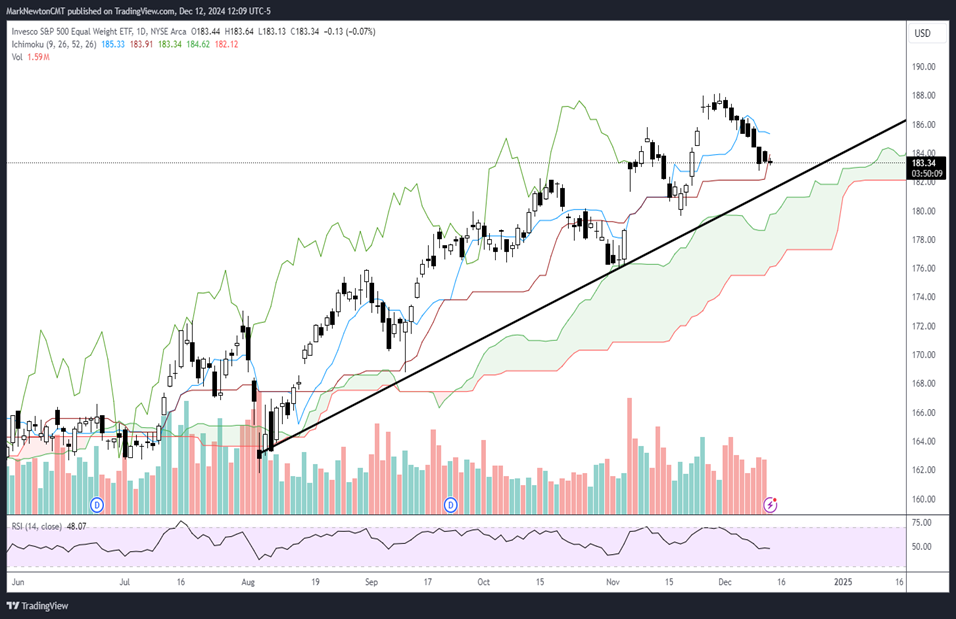
As shown below, the Equal-weighted S&P 500 ETF by Invesco (RSP) has fallen sharply in the last couple of weeks. However, this deterioration has not caused a breakdown in the larger uptrend for the S&P 500 on an Equal-weighted basis, and the price is now near support, which supports a rally.
This likely will translate into Small-caps, Transports, DJIA all pushing back to new highs into end of year.
Invesco S&P 500 Equal Weight ETF
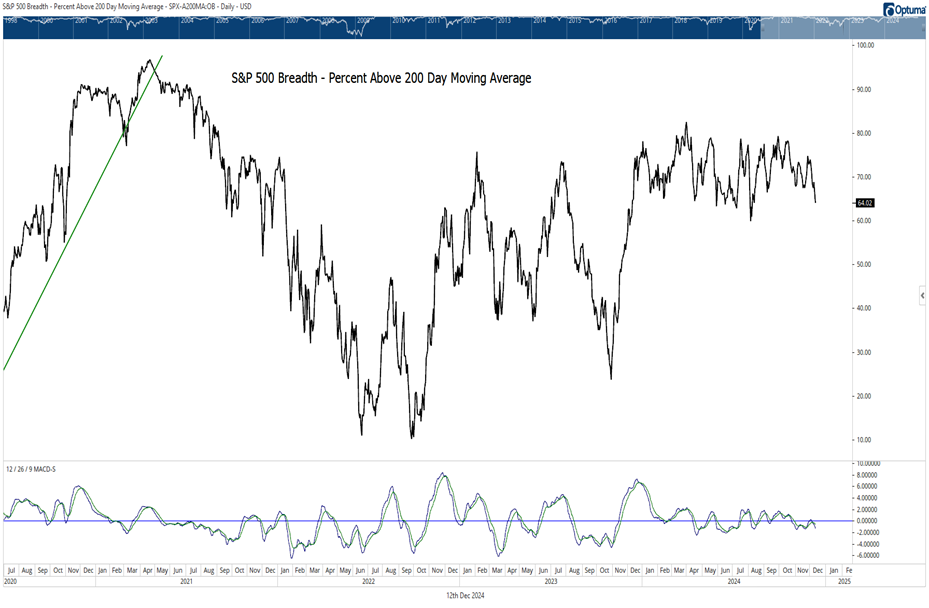
SPX Stocks above 200-day m.a. still above 60%
As shown below, the percentage of SPX names above their 200-day moving average (m.a.) has pulled back pretty sharply since September of this year.
This is one key gauge to watch which gives some perspective on market breadth.
While this has pulled back in the last month, given that over half the sectors were down on an Equal-weighted basis, the Percentage of SPX names above 200-day m.a. remains at 63%.
That’s not too problematic just yet, but the trend of the breadth deterioration has begun to pick up on the downside.
Ideally, this should stabilize and start pushing higher as SPX moves back to new highs and rallies, which hopefully happen on broad-based participation.
If this were not to happen as planned and only Technology leads the rally, then this would set up for a greater than likely possibility of a 1st Quarter correction.
Overall, I stand by Tom Lee’s calls that 1st Half 2025 proves better than 2nd Half and will show some technical charts and cycles to support this view in my 2025 Annual Technical Outlook on 1/7/25.
S&P 500 Breadth – Percent Above 200-Day Moving Average
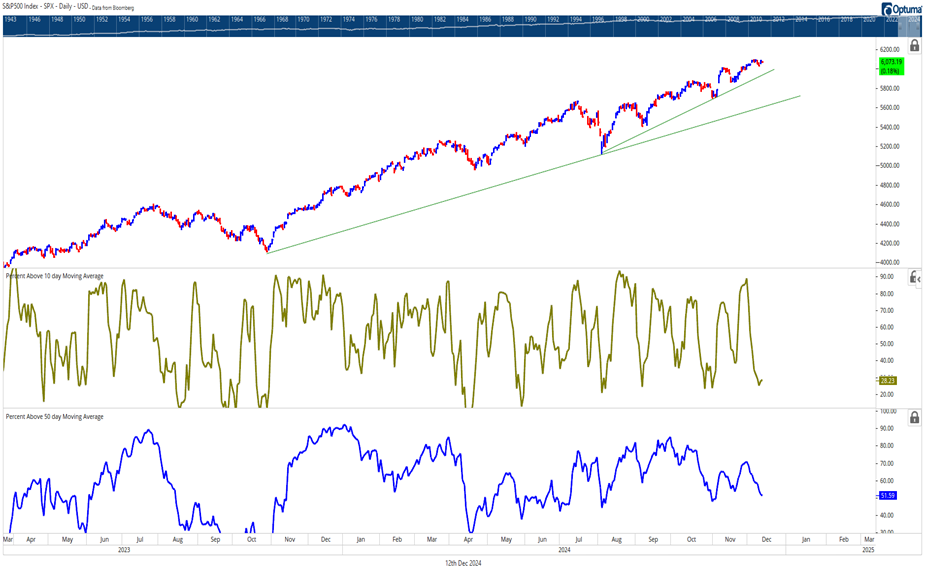
SPX shorter-term breadth gauges have waned sharply, but this doesn’t have to bring about a correction
As might be expected, in the 4th Quarter’s correction that “Wasn’t” we’ve seen the percentage of SPX names above their 10-day moving average (m.a.) drop down to 28% while the percentage above their 50-day m.a. has dropped to 51% despite a recent push in SPX and QQQ back to new highs.
Equal weighted SPX had dropped for eight straight sessions into this past Tuesday, 12/10, which was the longest streak of consecutive down days since 2018.
However, Technology’s resurgence has proven beneficial for US equity markets and has helped the major market gauges hold up despite some rather unsettling breadth issues.
Overall, I see this compressed breadth, for now, as being a factor that is constructive for buying dips in sectors like Industrials, Financials, and Discretionary.
S&P 500 Index – SPX – Daily – USD
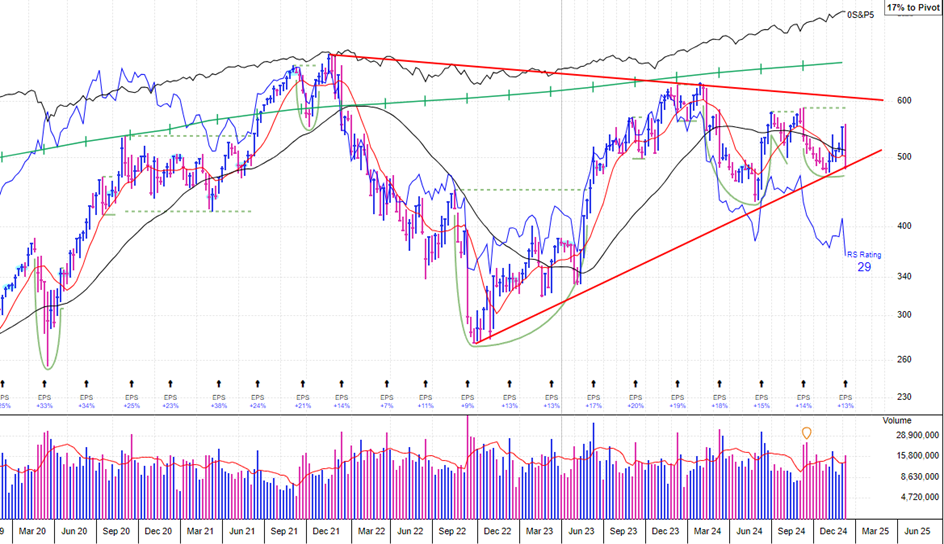
ADBE’s 12% decline today doesn’t change the technical picture too dramatically
Many had wondered about how ADBE decline might affect the Software space, as the company reported a rather conservative guidance on its AI adoption.
Technically speaking, this decline has proven to be a non-event at present, though today’s decline (12/12) did happen on above-average volume.
As can be seen below, ADBE has been one of the laggards of the larger names within Software, and has largely ground sideways in a triangle consolidation for most of the year (ADBE actually peaked out for the year back in February).
However, today’s weakness has not resulted in any meaningful technical deterioration for ADBE.
The key level for ADBE lies at $475, which will be important to hold to avoid a larger breakdown. If this is broken, then a test of May lows would prove forthcoming as the larger trend would be violated.
On the upside, regaining December’s peaks at $557.90 will be crucial in helping momentum start to improve and helping ADBE claw back toward the highs of its triangle pattern.
Overall, I don’t see today’s decline as too problematic. However, given the huge increase in Volume (9.83 million as of 12:00pm EST, the highest in over two months) we’ll need to see some effort in this bouncing on good volume back higher. If this cannot happen in January, then this could set up for a possible downside break of this triangle pattern into February.
At present, this hasn’t happened, and ADBE should likely stabilize near current levels in the near term.
ADBE