




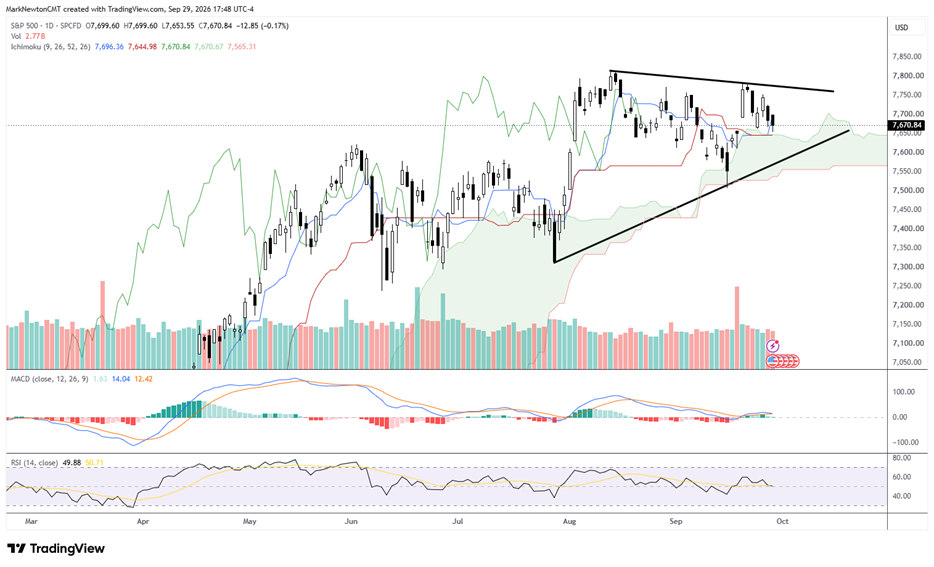
US equity trends remain positive but certainly quite choppy, as the ongoing Treasury selloff and gains in the US dollar and crude oil have continued to weigh on many US equity sectors. Until ^SPX and QQQ can climb back above the highs from late last week, some further near-term consolidation might be in store this week as the month and quarter come to a close. Sectors like Financials and Industrials seem close to support but thus far have not turned higher materially to help provide a tailwind and aid Technology in its own recent strength. Unfortunately, the US equity tape remains quite choppy and range-bound, and even on rallies back to new highs in October, one can’t rule out some backing and filling from late October into mid-November. Thus, fractional weakness this week won’t be something to give much attention to, and I expect this recent triangle consolidation plays out quite similar to the previous one from June–July. I like being long for rallies into late October and would utilize any and all pullbacks as an attractive risk/reward opportunity, not something which leads to meaningful weakness. While many investors remain concerned about factors like inflation, AI scare, and/or food and gas prices, the consumer seems to be spending, even if consumer stocks aren’t acting that well (more on this later in the report). The broader indices like ^SPX and the Nasdaq remain resilient, and it’s arguably right to use weakness to buy dips.
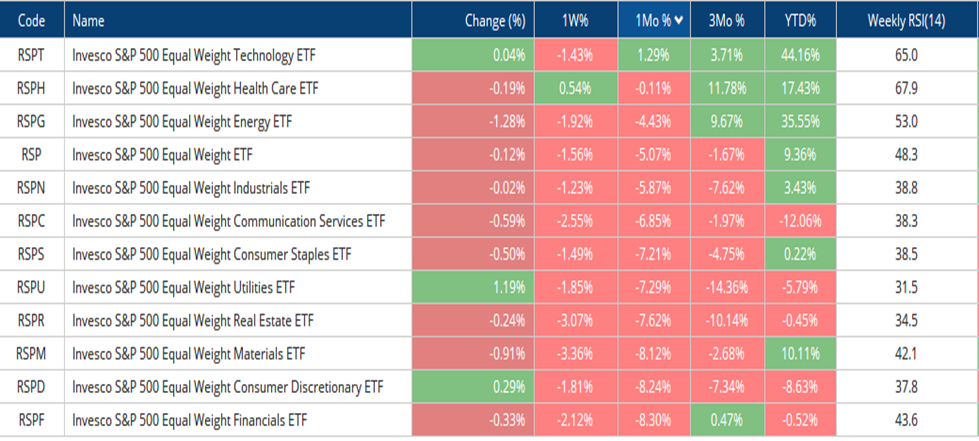
Incredibly enough, with one day left in the month and quarter, QQQ could possibly close above its former May 2026 monthly close of 736.73 to make a new all-time high, while ^SPX lies just 16 points below its own all-time high monthly close of 7,686.14. To say that equity indices have proven resilient in the wake of rising interest rates and high crude prices is an understatement. Yet as many investors are aware, ^SPX certainly does not represent “the stock market” when nine of the 11 major sectors have fallen more than 4% in the last month, with six sectors — Consumer Staples, Utilities, Real Estate, Materials, Consumer Discretionary, and Financials — down more than 6%.
There’s not a time this year when breadth figures have diverged so sharply from where ^SPX and QQQ lie (within striking distance of new all-time highs), yet such a divergence is rarely profitable to trust as being negative for the months ahead, specifically given Technology’s weight within the indices.
For those who remain tactically oriented, it’s important to know that neither ^SPX nor QQQ has undercut last week’s lows in a way that would lead to more near-term deterioration. However, barring an immediate about-face in interest rates and/or some stabilization in key sectors like Financials, there very well could be a minor breach of 7,662.58, or last Thursday’s intraday lows. Such a move would produce a likely short-term acceleration down to 7,636, or down to 7,592–7,600, which should be a very good tactical time to buy dips.
To expect that a rally back to highs should happen, ^SPX requires a move over 7,752. Until then, this pattern appears to be a classic “ABC” type formation which could bring about further weakness this week. I don’t like being bearish into end of quarter for anything more than 2–3 days, and feel that any minor weakness this week represents a very attractive risk/reward for ^SPX.
^SPX nearly set for positive gains to finish out September, even with rates rising sharply
Performance outside of Technology has proven dismal, but markets are holding up resiliently
While I am bullish on the prospects of a good Q4, I do share the concern that many sectors simply aren’t working that well.
Outside of Technology, Healthcare, and Energy, all other eight sectors are lower by more than 5% over the past month, with one more day left to go in the month and quarter.
Despite this initially being a concern regarding the defensive bond-proxy sectors showing weakness, the deterioration has spread to Financials, Consumer Discretionary, Industrials, and Communication Services.
As shown below, six sectors are lower in the rolling one-month period into 9/29/26 by more than 6%: Consumer Staples, Utilities, Real Estate, Materials, Consumer Discretionary, and Financials. That’s not encouraging, to say the least. However, with Technology at over 30% of ^SPX and acting fine, it’s not right to try to bet against this broader breadth deterioration.
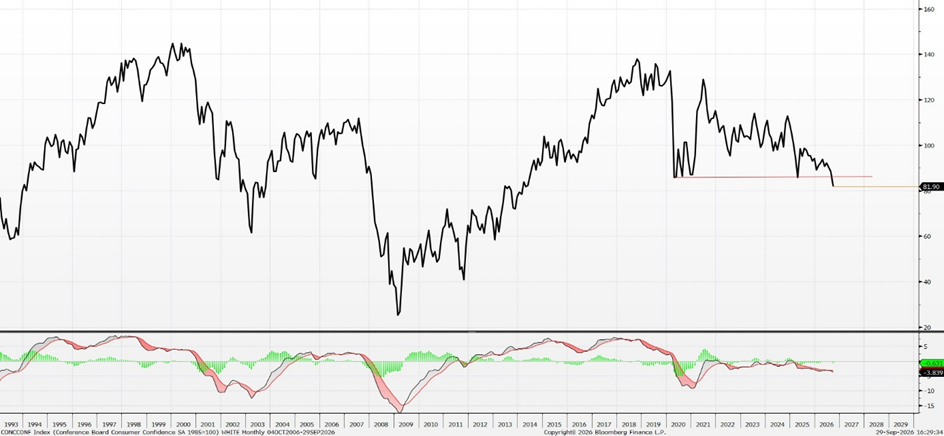
Consumer Confidence plunges to lowest levels since 2013
In what looks to be a negative for the consumer despite healthy levels of spending, Consumer Confidence data today dropped to the lowest levels since 2013. Today’s Conference Board number registered 81.9, or the lowest since 2014, and a six-sigma miss to the forecast of 89.0.
This likely is a larger positive for market sentiment, but many consumer stocks have fallen sharply in recent months despite the overall resilience in the stock market. (More on this to come.)
As shown below, the Consumer Confidence Index fell under two prior lows to reach 13-year lows as of this week. While this gauge is notoriously unreliable as a gauge for consumer spending, it does track what consumer stocks have done this year, based on both Consumer Discretionary and Consumer Staples, which have both proven to be big underperformers.
Until spending data starts to wane, my guess as a non-economist is that a plunge in consumer confidence is a notable positive from a contrarian perspective on the stock market and economy, despite it likely signaling a frustrated consumer given high food and gas prices.
Consumer Discretionary is being lowered to Underweight, and it’s very important to be selective
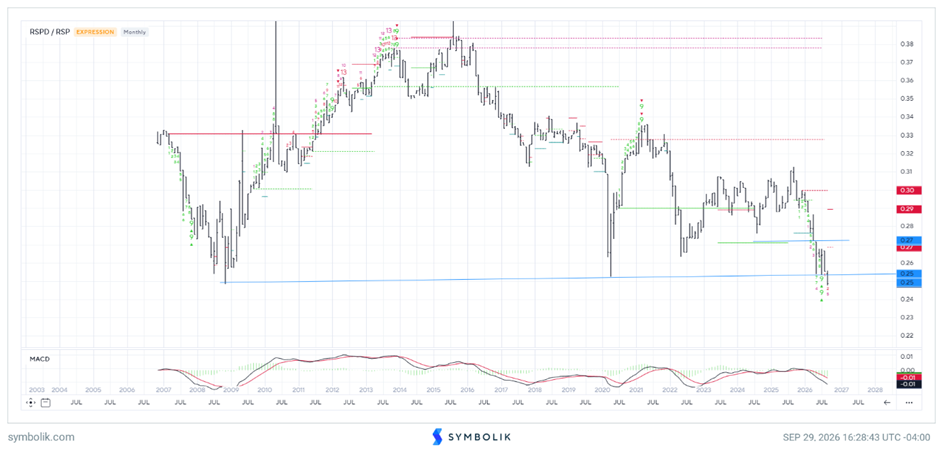
Incredibly enough, Consumer Discretionary (“Discretionary”) has fallen under 2020 and 2008 lows when viewed as a relative relationship between the equal-weighted Consumer Discretionary ETF by Invesco (RSPD) vs. the equal-weighted S&P 500 (RSP). (Note: both of these were used to avoid distortions from ETFs like XLY, which contain heavy weightings in stocks like TSLA and AMZN. Furthermore, viewing it vs. RSP instead of SPY reduces the influence of Technology on the ratio, given ^SPX’s heavy Tech weighting.)
As shown above, Consumer Discretionary has been the second-worst sector in equal-weighted terms behind Communication Services this year, while second-worst only to Financials in rolling 30-day performance into 9/29/26, with returns worse than 8%.
Simply stated, one requires extreme patience and selectivity when attempting to own this sector, and technically my 10 favorites, if I was forced to own Consumer Discretionary, would be the following:
GRMN, TSLA, HLT, WSM, EBAY, MAR, AMZN, EXPE, RL, and GM.
Outside of these stocks, I don’t find much appealing beyond the top 20 performers, and feel that with many casino stocks down more than 50% from all-time highs and interest rate spikes negatively affecting Homebuilder stocks, extreme patience will be required.
I am lowering my rating from Neutral to Underweight as of the end of September, given the break in RSPD to multi-decade lows vs. the equal-weighted S&P 500 in ratio form. Until this sector starts to show better strength, it’s better simply to stick with Technology.
RSPD / RSP — Consumer Discretionary has violated decade lows when viewing relative charts of Discretionary vs. S&P 500 (both in equal-weighted terms)
Market breadth has contracted to the lowest level since spring 2026 lows, but “Mr. Market” just doesn’t care
It’s unusual to see breadth continue to fall with stock indices so resilient, as the percentage of stocks under their 200-day moving average (m.a.) has broken 50% within the Russell 3000 index, while even the percentage of stocks under their 50-day m.a. has undercut 25%.
That’s quite extreme for the Russell 3000, a much broader-based index than the S&P 500. As noted earlier in the report, all that’s required is a 17-point gain tomorrow for ^SPX to close positive to end the month and quarter, despite over half the sectors lower by more than 6% in the rolling 30 days.
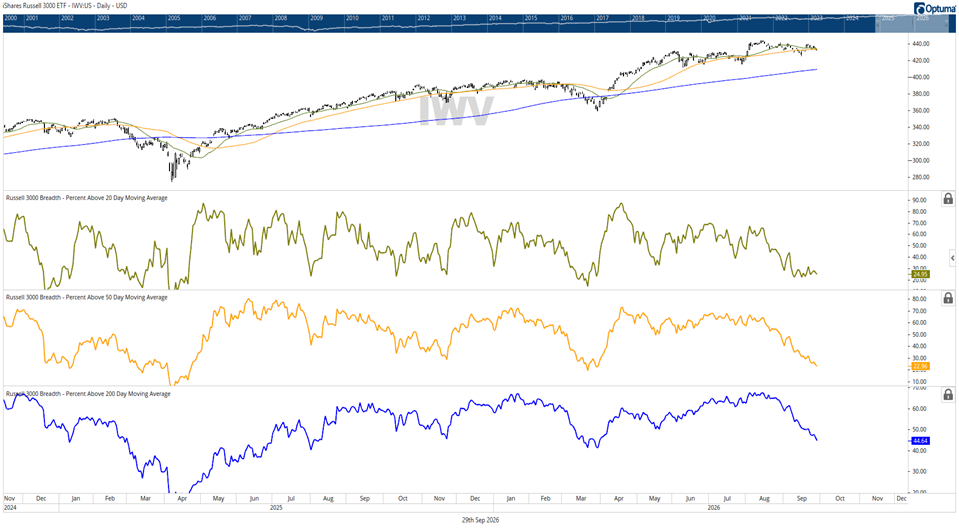
As I like to say, when breadth falls sharply and investors as a group are quick to point this out, it’s normally not the market that’s wrong; it’s the bearish investors that are wrong. If markets start to weaken, then it’s right to respect that. For now, as long as Technology is holding up quite well, I don’t see markets showing much weakness this fall, and it should be the broader market which eventually starts to play catch-up and rallies back.
______________________________
PS: If you are enjoying our service and its evidence-based approach, please leave us a positive 5-star review on Google reviews —> Click here.