




US equity trends remain positive as the third quarter comes to a close, but the tape has been choppy and range-bound for two months now, as the Treasury selloff, US dollar strength, and elevated crude prices have kept most sectors outside of Technology under pressure while the cap-weighted indices hover just beneath all-time highs. Energy had been the one group outside of Technology showing real relative strength, and even that has begun to stall, while the bond-proxy sectors like Utilities continue to suffer from rising yields, and Financials have broken their own relative uptrend without yet finding a floor. The consumer remains the weak link, though the relationship between Discretionary and Staples has now reached long-term support, which suggests the worst of Discretionary’s underperformance vs. Staples might be near an end. Bottom line, none of this changes my view that this index consolidation should resolve to the upside in October in a manner similar to the June–July triangle, and it’s right to use any early-October weakness as a buying opportunity for a rally into late October. Technology and Healthcare remain sectors to favor, and until Treasury yields show evidence of peaking, it’s premature to expect the laggards to provide much of a tailwind. I’ll discuss more with charts and commentary in today’s report.
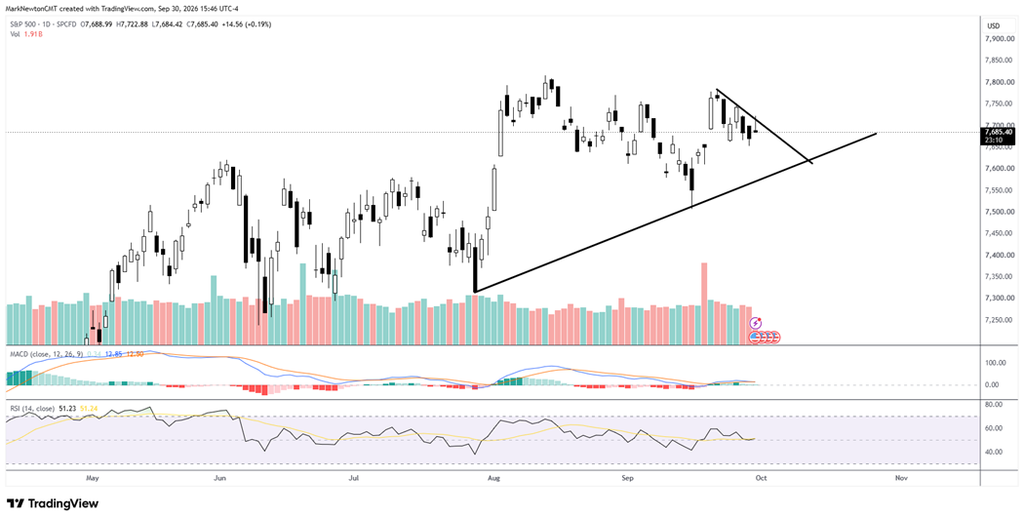
^SPX remains range-bound within its triangle from early August, and a move over 7,752 is still required to expect a rally back to new highs
Not much has changed from last evening. The early strength in Technology persisted, as Technology and Communication Services were the only two sectors out of 11 which were positive today, with XLK (large-cap Technology) up 1.00% while most sectors fell, and Financials, Healthcare, Industrials, and REITs all down more than 0.90%. Thus, this was a mildly negative breadth day, but one which could have been quite a bit worse had it not been for Technology strength into Micron earnings tonight.
To the Nasdaq-100 index’s credit, the Nasdaq (and by extension the Nasdaq-100 ETF, QQQ) did successfully make a new all-time high on a monthly close today, while ^SPX fell just shy after having achieved positive returns for the month early in Wednesday’s session before slipping into the close to finish the month just negative.
Both QQQ and ^SPX lie in short-term triangle patterns, not dissimilar from that which ruled price action throughout June and July. My expectation is that both QQQ and ^SPX are close to a time when the trend starts to push back to new highs, which could occur on positive developments in the Middle East which cause crude oil to roll over and interest rates to follow suit. For now, 7,752 needs to be exceeded in ^SPX, and until that happens, minor backing and filling could very well be possible this week before the uptrend reasserts itself in October.
Tactically, any early-month weakness to near 7,662.58, last Thursday’s intraday low, would initially be important, followed by 7,600–7,636, a support zone which I’d view as a very attractive risk/reward opportunity to buy dips.
S&P 500 Index (^SPX, daily) — Triangle consolidation from early August is narrowing, with resistance at 7,752 and support at 7,662, then 7,600–7,636
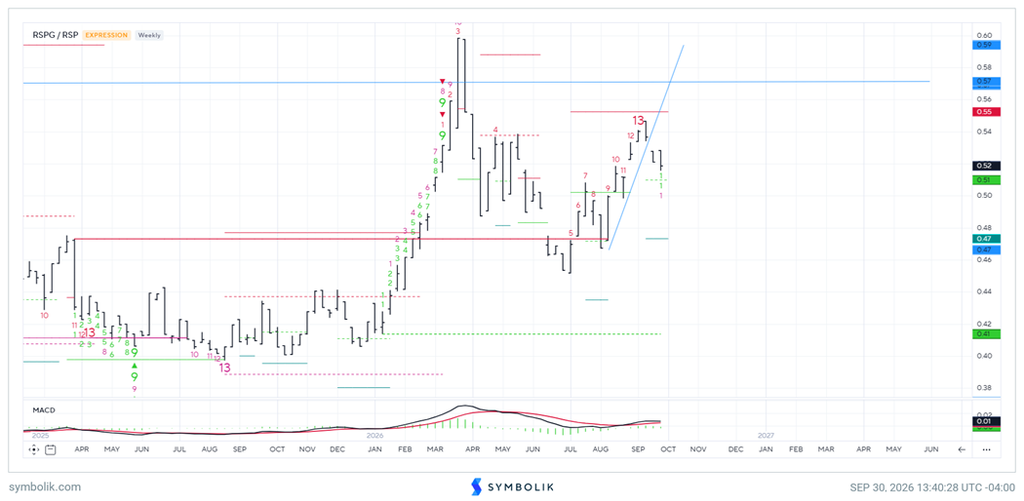
Energy’s relative surge since August has stalled following weekly DeMark exhaustion, and a pullback to 0.50–0.51 is likely before this can resume higher
The weekly ratio of equal-weighted Energy to equal-weighted S&P 500 (RSPG/RSP) had been one of the few bright spots in relative terms outside of Technology since August, rallying sharply from 0.47 to a peak of 0.55 two weeks ago as crude oil pushed higher. However, that peak coincided with a TD Sequential 13 Countdown signal on weekly charts, and the ratio has since fallen for two straight weeks to 0.52, undercutting the steep uptrend line from the August lows in the process.
This doesn’t mean Energy’s intermediate-term outperformance is over, but it does argue that the easy money has been made for now, as both crude oil and the Energy sector have been weakening and a possible drop in crude oil is starting to look increasingly possible during the seasonally weak months of October into November.
Overall, the break in Energy over the last few weeks has caused technical trends to turn a bit more negative, and it looks right to be Neutral on Energy until this recent weakness can show evidence of stabilizing and pushing higher.
Bottom line, I removed VLO from the Upticks list last month and feel it’s right to reduce Energy to a technically Neutral ranking ahead of possible crude weakness into the midterms.
RSPG / RSP (equal-weighted Energy vs. equal-weighted S&P 500, weekly) — Trend violation on relative charts given DeMark TD Sequential 13 “sells” suggests further weakening
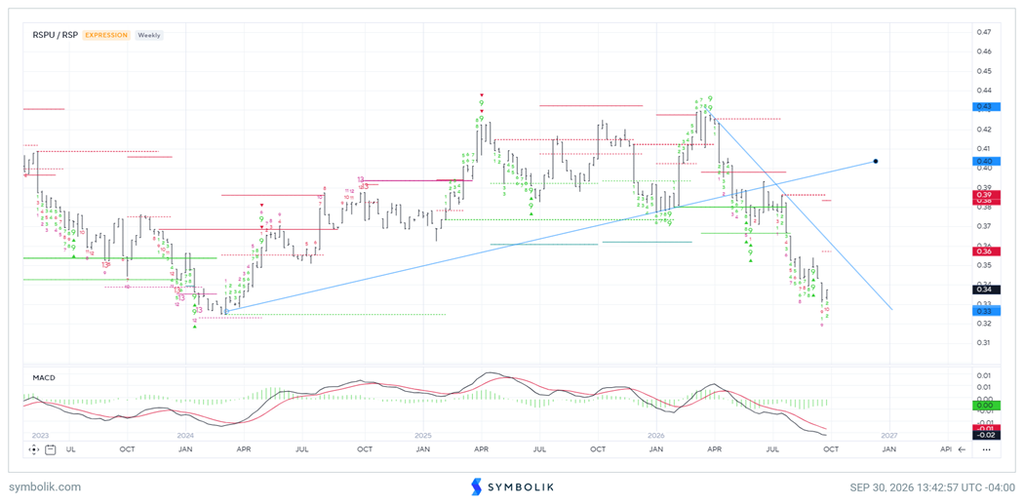
Utilities have fallen to the lowest relative levels since early 2024, and it’s premature to expect a turn until Treasury yields peak
The weekly ratio of equal-weighted Utilities to equal-weighted S&P 500 (RSPU/RSP) shows just how much damage the Treasury selloff has done to the bond-proxy sectors. After peaking in April near 0.43, this ratio broke its uptrend from the early-2024 lows over the summer and has since fallen to 0.34, its lowest level since January 2024, and weekly MACD remains deeply negative.
Utilities have broken down on a cap-weighted basis, and equal-weighted Utilities vs. equal-weighted S&P 500 also shows evidence of weakening sharply in a manner which suggests more underperformance is likely in October.
Given the inverse relationship between this sector and interest rates, it’s likely that a relative bottom in Utilities coincides with a peak in Treasury yields, and until that happens, this remains a group to avoid technically. (I had written about the possibility of an October/November peak in long-term rates, and for now, it looks early for the Utilities sector, ^TNX, and TLT to produce signals which might show a trend reversal.) Thus, this Utilities weakness likely continues.
RSPU / RSP (equal-weighted Utilities vs. equal-weighted S&P 500, weekly) — Ongoing weakness warrants downgrading further to Underweight heading into October
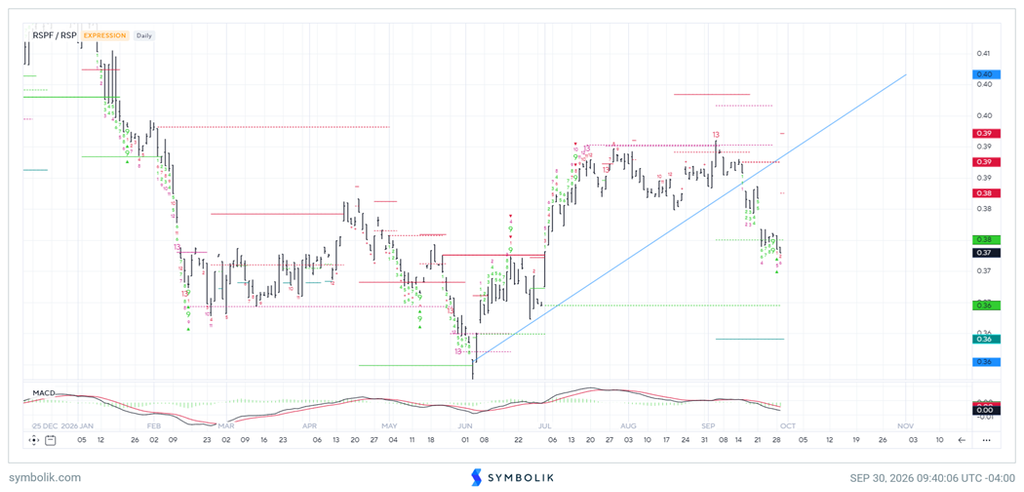
Financials have broken their relative uptrend from June, and a recapture of 0.38 is needed before this group can provide a tailwind
The daily ratio of equal-weighted Financials to equal-weighted S&P 500 (RSPF/RSP) peaked in early September near 0.39, right as a TD Sequential 13 Countdown signal registered, and has since fallen sharply, breaking the uptrend line from the early-June lows in mid-September and undercutting TDST support at 0.38 in the process. The ratio now sits near 0.37, its lowest level since early July, and daily MACD is negative.
As mentioned in last night’s report, Financials seem close to support but haven’t yet turned higher materially, and this definitely represents a headwind toward the broader market starting to turn higher and join the strength in Technology.
While a bounce in this sector likely happens in October, it’s hard to put much faith in Financials’ ability to lead given the above-average weakening in relative and absolute trends.
Overall, this matters for the broader market, as Financials, along with Industrials and Healthcare, are the sectors that need to start joining Technology if breadth is going to improve in October. For now, my expectation is that Financials stabilize in the week ahead and begin a bounce. However, I’m skeptical that this sector can show outperformance until the yield curve starts steepening again.
For now, heading into October, Financials are a Neutral, technically speaking, as a bounce is overdue, but this sector likely cannot keep up with the broader market, and most certainly not Technology, in my view.
RSPF / RSP (equal-weighted Financials vs. equal-weighted S&P 500, daily) — Weakness warrants being patient on Financials, and this group looks Neutral, technically, for the next month
Discretionary vs. Staples has reached a major multi-year uptrend line with weekly DeMark exhaustion, which favors Discretionary over Staples from here
While Consumer Discretionary (“Discretionary”) was lowered to Underweight last night given its plunge to decade lows vs. the equal-weighted S&P 500, it’s important to distinguish between how Discretionary looks vs. the broader market and how it looks vs. its consumer counterpart, Consumer Staples (“Staples”).
My view is that 2026 underperformance in Discretionary vs. Staples has not proven nearly as technically damaging as what happened back in late 2021 into 2022, which ushered in the start of the bear market in equities.
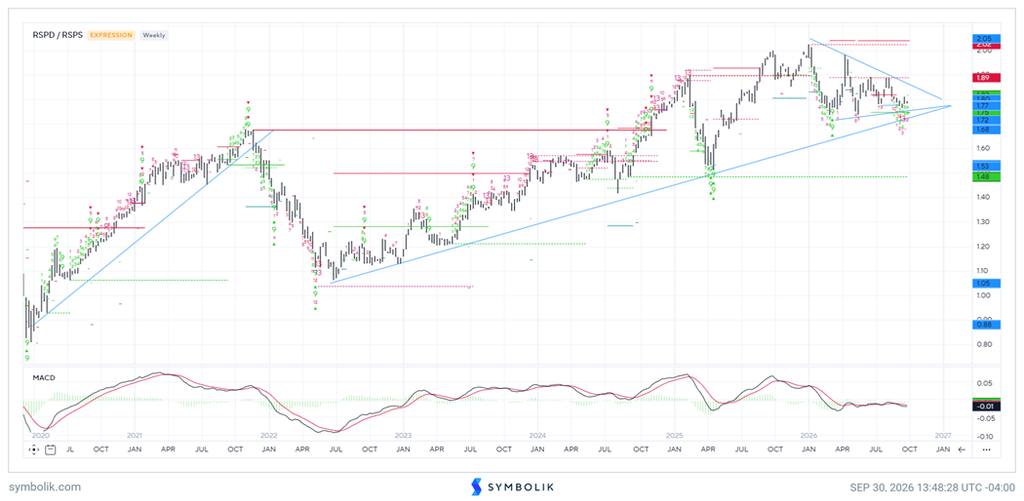
As shown below, the weekly ratio of equal-weighted Discretionary to equal-weighted Staples (RSPD/RSPS) has pulled back from its late-2025 peak near 2.05 to roughly 1.72 and has now arrived at the rising trendline connecting the 2020 and 2022 lows, one of the more important long-term support lines on a chart that consistently is important to monitor as a “risk-off” gauge.
Thus, both consumer sectors remain groups to underweight vs. Technology, but for those forced to choose between the two, Discretionary should begin to outperform Staples from these levels, and a move back above 1.77–1.80 would confirm that a relative low is in place. This fits with the contrarian read on the plunge in Consumer Confidence discussed last night, and it would take a break of 1.68 to change this view.
Bottom line, despite the relative weakness in Discretionary, it remains trending up vs. Staples, and it’s right to consider that Discretionary outperforms Staples into year-end.
RSPD / RSPS (equal-weighted Discretionary vs. equal-weighted Staples, weekly) — Pullback to the multi-year uptrend suggests important support in RSPD/RSPS that favors Discretionary
Overall, the quarter ends with ^SPX still range-bound within its triangle from early August, and while a move over 7,752 is required before a push to new highs can begin, I expect this pattern to resolve higher in October as the previous one did. The sector picture remains challenging, as Energy’s relative strength has stalled after DeMark exhaustion, Utilities remain hostage to Treasury yields, and Financials need to stabilize and turn up to help the broader equal-weighted S&P 500. Finally, the arrival of Discretionary vs. Staples at major long-term support is one encouraging sign for the consumer, even if both Discretionary and Staples look like laggards to the broader market. It’s right to use early-October weakness to buy dips in both ^SPX and QQQ for a rally into late October, favoring Technology, and to remain patient with the laggards until yields show evidence of peaking.
______________________________
PS: If you are enjoying our service and its evidence-based approach, please leave us a positive 5-star review on Google reviews —> Click here.