







STRC Continues to Move in the Right Direction: One of the more encouraging developments over the past several sessions has been the continued recovery in STRC. The preferred security has now rebounded from below 72 last Friday to nearly 88, suggesting investors are gradually regaining confidence in Strategy’s balance sheet following Monday’s 8-K. As discussed earlier this week, STRC has become one of the best barometers for gauging how the market views Strategy’s capital needs. The closer STRC trades toward par, the less pressure there should be on the company to monetize BTC in order to support the preferred complex. While it is still too early to declare the issue resolved, recent price action is moving in the right direction. Monday’s upcoming 8-K should provide additional confirmation as to whether Strategy continued raising capital throughout the week.
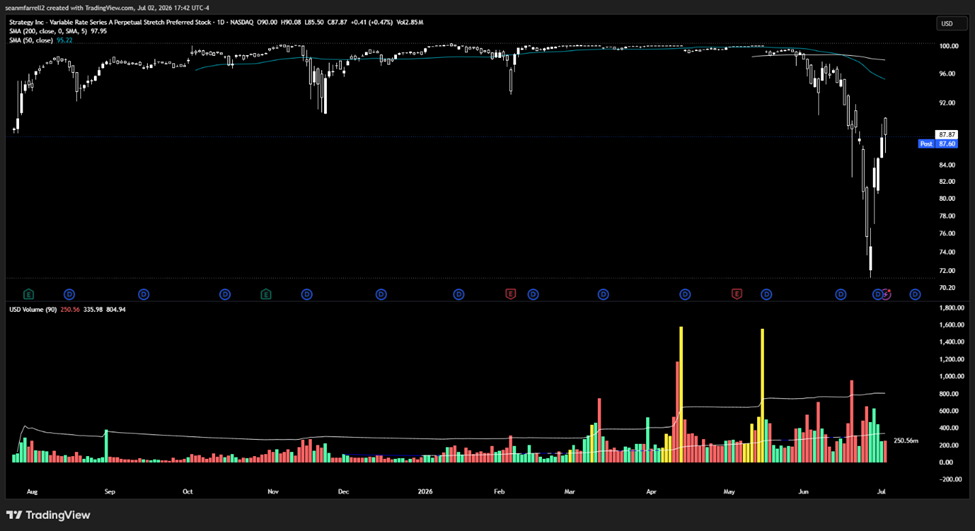
A Higher MSTR Common Stock Is Also Constructive: The recent rebound in MSTR common is equally important. With the stock once again trading above 1.0x mNAV following a (likely) short squeeze, Strategy has regained the ability to raise equity capital without immediately resorting to BTC sales. While issuing common at these levels is not especially accretive to existing shareholders, it is nonetheless preferable to selling BTC. Taken together, the combination of stronger STRC pricing and improving MSTR common suggests the immediate balance sheet concerns that weighed on crypto last week are beginning to ease.
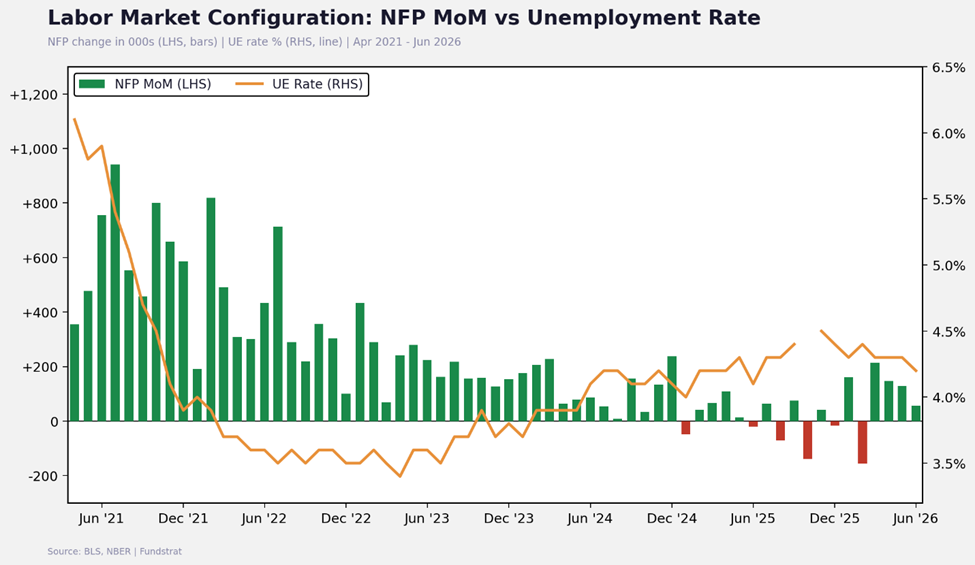
Labor Data Brings the Fed’s Employment Mandate Back Into Focus: Turning to macro, today’s employment report was modestly constructive from a liquidity perspective. Nonfarm payrolls came in below expectations, while April and May payroll figures were revised materially lower. Although the unemployment rate declined to 4.2%, the improvement was driven almost entirely by lower labor force participation rather than stronger hiring. In other words, the labor market appears softer than the headline unemployment rate alone would suggest.
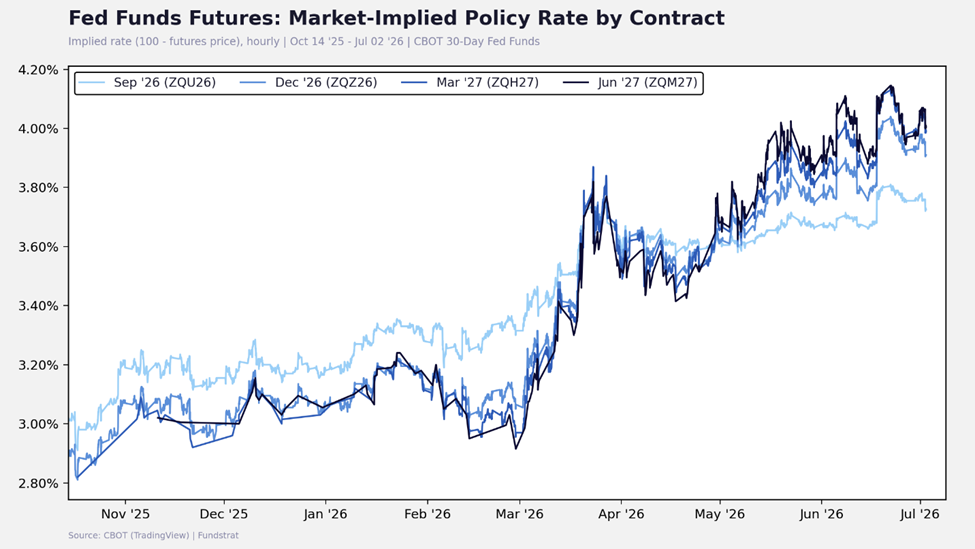
Markets Responded with a Dovish Repricing: Rates markets largely interpreted the report in a constructive manner. Fed Funds futures moved modestly more dovish while the yield curve steepened, reversing part of the hawkish repricing that followed the recent FOMC meeting. This matters because crypto has spent much of the year contending with rising real yields and increasingly restrictive liquidity conditions. While today’s data hardly guarantees an easier policy path, it does bring the employment side of the Fed’s dual mandate back into the conversation. If labor data continues to soften over coming months, markets may begin pricing additional easing without requiring the Fed to materially change its rhetoric.
Would be Patient on Miners, But Story Does Not Strike Me as “Over”
Semis and memory are selling off on concerns around compute capacity overbuild and the potential for hyperscalers to shift toward lower-cost hardware alternatives. For most of this year, MAG7 stocks have been under pressure as rising DRAM prices and broader concerns around semiconductor spend fueled investor angst over escalating AI infrastructure costs (“sell the buyers and buy the sellers”).
This week, however, MAG7 has stabilized as investors have rotated back into the group on the view that hyperscalers may ultimately moderate AI capex growth in response to shareholder pressure. Today’s weakness in miners (data center shell and power access plays) appears to be an extension of that broader unwind in AI infrastructure beneficiaries, given their perceived sensitivity to AI capex spending.
Stepping back, though, it’s worth asking how sensitive these businesses really are to any moderation in AI capex (assuming that’s even the right operating assumption, which remains unproven).
Chips and memory are finished goods and have historically been cyclical. Demand strengthens, pricing rises, supply responds, and eventually the industry works through another supply glut. Access to power and data center infrastructure strikes me as a different business. New generation capacity requires long development timelines, regulatory approvals, transmission and grid connections, and substantial capital investment. Likewise, there is only so much suitable real estate near existing grid infrastructure that is outside densely populated areas. Those supply constraints should make power and data center capacity inherently scarcer (“less elastic”) than the underlying hardware supply chain.
The more important question, in my view, is whether demand for compute is actually declining. My impression is that it is not. Hyperscalers may migrate from the big three DRAM suppliers to lower-cost Chinese alternatives. They may diversify GPU suppliers or increasingly rely on internally developed accelerators such as Google’s TPUs. Enterprise AI users may shift from proprietary frontier models toward open-source alternatives. But none of those developments necessarily imply lower token demand. If anything, they primarily represent efforts to lower the cost of producing tokens. Compute demand, power demand, and the need for physical data center capacity could all remain intact.
For that reason, while miners may continue to trade with the broader AI infrastructure unwind in the near term, I suspect there is an opportunity for them to become less correlated with semis and memory over the coming weeks. I’ll be watching spreads like WGMI/SOXX and WGMI/DRAM for any indication of that decoupling.
Of course, if the selloff persists at this pace into next week, we may reach a point where relative performance no longer matters and these names simply become compelling on an absolute basis.
There is also a potential catalyst in late July or early August, when ERCOT is expected to announce the next round of data center capacity approvals.
The last point I’ll touch on is META’s announcement yesterday that it intends to sell excess data center capacity to third parties. The broader AI infrastructure complex sold off as this was interpreted as an admission that hyperscalers have overbuilt compute capacity (this would be negative for miners). Yet META shares rallied, reflecting the view that the company will ultimately be able to monetize that excess capacity and improve returns on invested capital. Those two interpretations are difficult to fully reconcile. If META can successfully monetize excess capacity, then the demand for compute still exists. The implications may still be negative for chip and memory suppliers, where demand could shift toward lower-cost alternatives, but they are not necessarily negative for owners of scarce power and data center infrastructure.
I’ll continue digging into today’s move and will share more thoughts as they develop, but these are my initial reactions to the miner selloff.
Securitize: Right Company, Wrong Price, Could Be a Nice Tactical Long on Clarity Progress
- Securitize went public on July 1st through a de-SPAC merger with Cantor Equity Partners II and began trading on the NYSE as SECZ yesterday, opening around $12.72. The deal came together cleanly by SPAC standards: redemptions were low at just 6.84M shares (roughly 28.5% of the public float), preserving most of the trust proceeds and, combined with a $225M PIPE, delivering about $400M in gross proceeds. The company emerges with roughly $376M of net cash and no funded debt, since the $79.9M in convertible notes converted to equity at close, leaving 166M shares outstanding and about 180M diluted.
- The company itself, founded in 2017 by Carlos Domingo, is the largest institutional tokenization platform by AUM and the only vertically integrated, SEC-regulated operator in the space. It owns the full stack: a registered transfer agent, a broker-dealer, and ATS in Securitize Markets, and a fund administrator in Securitize Fund Services (scaled through the MG Stover acquisition), with an RIA arm planned. It’s the first pure-play tokenization infrastructure company to list on a major US exchange, and in a fitting demonstration of the platform, it tokenized its own stock on day one.
- The business earns revenue in two ways. Tokenization, which did $37.4M in FY25, generates integration fees for bringing assets on-chain, ongoing maintenance, and AUM-based distribution economics. Asset Servicing, at $24.7M, is transfer-agent SaaS plus AUM-based fund administration fees. Fundamentally, it’s an asset-gathering business, and management is explicit that tokenized AUM is the “North Star” that drives everything else.
- Competitively, Securitize sits between wrapper-token issuers like Ondo and Backed, which operate outside the securities framework and compete on lower implementation friction, and the eventual threat of large managers building in-house, which Franklin Templeton’s Benji platform proves is possible. Its licensing stack took years to assemble, and the market has validated it: NYSE chose Securitize as its digital transfer agent and Computershare chose to partner rather than compete. The caveat is that the licensing stack doesn’t guarantee retention of the flagship client. BlackRock’s contracts renew annually, are terminable on 90 days’ notice, and carry no exclusivity.
- The company’s traction is real. Revenue grew 234% to $62.2M in FY25 on KPMG-audited numbers and another 39% year over year in Q1’26, with adjusted EBITDA turning positive in FY25. The platform supports about $4.28B in tokenized value anchored by BlackRock’s BUIDL at $2.23B, alongside Apollo, KKR, Hamilton Lane, VanEck, and BNY. But the fine print matters: core tokenization revenue was flat year over year in Q1, and most of this year’s AUM rebound traces to a roughly $760M April markup of the BCAP III venture fund rather than organic inflows.
- The growth story rests on a very large TAM, with RWA forecasts running anywhere from $2T to $30T by the early 2030s, plus several meaningful call options: native tokenized public equities (management targets ~75 issuers by end-2026), tokenized treasuries as stablecoin reserves after the GENIUS Act, the NYSE digital trading platform rails, and the Computershare channel. Management guides FY26 to $110M of revenue and $32M of adjusted EBITDA on an AUM ramp to roughly $9B.
- The risks cluster around three things. Concentration is the biggest: BUIDL and BCAP together are about 75% of platform value, and two customers were roughly 21% of FY25 revenue. Execution credibility is second: management missed its own roadshow projections within weeks of publishing them, and the S-4 itself concedes the FY26 AUM ramp is unlikely to be met. And the model carries genuine crypto beta, since the marginal buyer of tokenized treasuries is crypto-native, the fund-admin book marks to digital-asset prices, and the corporate treasury holds crypto. Layer on a supply overhang where 69% of shares unlock within 180 days (earlier at $15-$20 VWAPs), and the setup warrants caution.
- On valuation, the stock at $12.72 carries a $1.9B enterprise value, which is about 31x trailing revenue and 67x my base-case FY28 adjusted EBITDA of ~$29M. That base case assumes tokenized AUM roughly doubles from $3.1B at year-end 2025 to $5.0B by end-2026 (vs. management’s $9B target) and reaches ~$8.7B average by FY28, while the tokenization take rate fades from ~110bps to ~90bps as the mix skews toward low-fee treasury products, and asset servicing grows to ~$47M on the fund-admin book. That builds to ~$125M of revenue and a ~23% adjusted EBITDA margin by FY28.
- The view, then, is right company, wrong price. This is the cleanest institutional tokenization pure-play in public markets, with real revenue and the best partner roster in the category, but today’s valuation already discounts much of the bull case. I might be “mid-curving” this one, but I am not paying 67x FY28 adjusted EBITDA for a company with this much execution risk, large TAM and all.
- One important caveat is regulatory. If the Clarity Act gains meaningful momentum, SECZ could become a narrative-driven beneficiary as investors seek direct exposure to tokenized securities infrastructure. That could support a tactical long, particularly if legislative progress occurs ahead of the major share unlock.
Bottom Line: The near-term backdrop continues to improve incrementally. Strategy-related balance sheet concerns are easing, labor market data has reopened the possibility of a more accommodative policy path, and rates markets have begun to respond accordingly. None of these developments, individually, are enough to justify becoming aggressively bullish. However, taken together they do suggest that some of the headwinds weighing on crypto over recent weeks are beginning to moderate. I continue to favor patience, but I also think the case for a tactical rally is becoming increasingly credible should these trends persist.
Tickers in this video: BTC -1.97% STRC MSTR META SECZ WGMI SOXX DRAM
______________________________
PS: If you are enjoying our service and its evidence-based approach, please leave us a positive 5-star review on Google reviews —> Click here.