



Chart of the Day
Good morning!
There was something for both the hawks and the doves in the latest jobs report.
The U.S. economy lost 23,000 jobs in July, a big miss considering the expectations were for an 83,000 increase. The hiring strength of previous months was also a mirage. In May and June, the economy added 103,000 fewer jobs than expected.
The unemployment rate, as has become the trend, edged down to 4.1% from 4.2% in June. At first glance that seems like a sign of strength for the job market, but a closer look suggests this isn’t really the case. That’s because the total number of employed people decreased in July, so the only way for the rate to have decreased is if some unemployed people left the labor force.
The labor-force participation rate, which has been gradually declining all year, fell to 61.4%, the lowest level since February 2021, with the decrease driven by the 55-and-older cohort. Their participation rate is the lowest since March 2005, while employment for those between 25-54 increased. There’s not really a clear reason for why older Americans are dropping out of the workforce. Companies might just be letting workers retire without replenishing their positions, or some workers might be choosing to retire while the stock market’s at records.
The weakness is undoubtedly a shock given the past few months’ illusion of strength, but it’s good news for Federal Reserve Chair Kevin Warsh who is under pressure from economists to raise interest rates to tackle inflation. This latest jobs report arguably strengthened the view that Warsh and the Fed simply cannot raise interest rates when the average 12-month labor market gain is at 34,000 because it would likely chip away at whatever resilience is left. As a result, odds of a September rate hike sank to 42.3%, compared with 55% on Thursday, and sent the S&P 500 0.6% higher to fresh all-time highs on Friday.
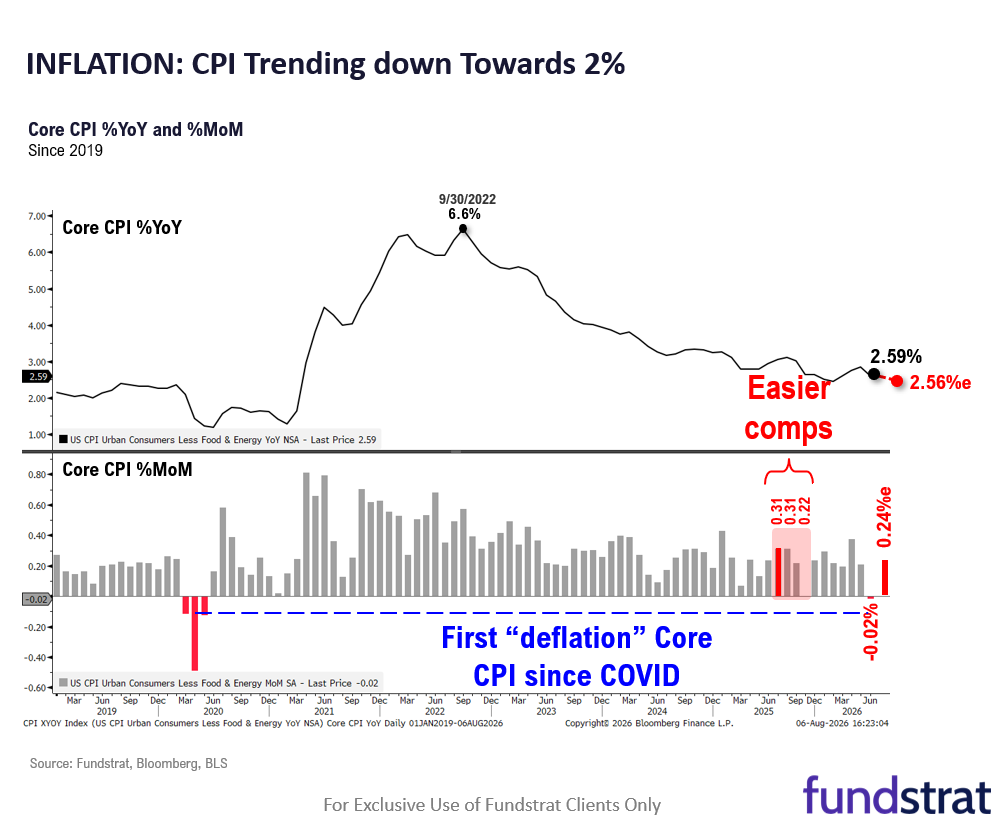
One could, however, argue that rate hike expectations should have moved down more, given that of the five biggest contributors to monthly core inflation — airfares, shelter, apparel, recreation, and household furnishings — three aren’t even likely to see prices decline in response to hikes, as Fundstrat Head of Research Tom Lee as previously pointed out.
The lack of a bigger downward move shows that investors are hesitant to take a side in this new era without forward guidance. Mixed signals on almost every report, meanwhile, have made it hard for everyone from policymakers to seasoned economists to figure out where the economy is headed.
The average miss on jobs report, for example, is 108,000 this year, the highest since the 133,000 of 2022’s chaotic job market.
That makes it all the more important to go back to what I said back in early July: The job market’s strength is pretty much the sole determinant of rates now. Extended strength in the labor market would make it easier for the Fed to justify hiking interest rates, but if hiring has weakened, then it would justify holding rates steady and perhaps even cutting.
We will get one more jobs report before the Fed’s next meeting on Sept. 16. I don’t really have high hopes of getting any insight from Warsh at Jackson Hole from Aug. 27 to 29 because it’s not like seeing the Teton Range will suddenly compel him to share forward guidance. To me, this means that investors should ignore this weak jobs report because by September, this will be old news.
Share your thoughts
What do you make of this labor market? Click here to send us your response.
📧✍️Here’s what a reader commented📧✍️
Q: Do you think expanded mortgage-loan volumes are a good way to solve our housing-affordability problem?
A: If it addresses affordability through reduced rates, yes. The GFC wasn’t caused by hardworking young couples losing their jobs or over-extending themselves on their primary home. It occurred because of investors, i.e. cab drivers buying five homes using no-doc loans looking for a flip. Once the music stopped, the unwind caught these hardworking people and their primary residences, but they weren’t the cause.
Catch up with Fundstrat
We believe we are witnessing the 3rd derangement syndrome in 30 years. This time it is ‘inflation derangement syndrome,’ and this is causing investors to fret about resurging inflation and thus, want the Fed to hike needlessly. We discuss how July jobs and July CPI likely reduce fears to an extent, and this is a catalyst to push markets higher into month end.
Technical
Software arguably remains a better area for positioning within technology than semiconductors at the moment, following the June breakout in the IGV/SOXX ratio, while to me, memory stocks have not yet stabilized sufficiently vs. equal-weighted technology to merit overweighting.
Crypto
It appears that Clarity will not receive a Senate vote before the August recess, and there still seems to be meaningful work remaining around ethics and potentially stablecoin yield before the Senate reconvenes in September. The good news, from a markets perspective, is that most, if not all, of the downside of a “no Clarity” scenario is already reflected in prices. That leaves some attractive asymmetry.
News We’re Following
Breaking News
- Iran insists Strait of Hormuz will stay closed until Trump agrees to demands NYT
Markets and economy
- Kalshi ties up with Nasdaq to bolster trade surveillance REU
- China bypasses shipping chokepoints with ‘Ice Silk Road’ through Arctic FT
Business
- Meta to open source its most powerful AI model as it takes swipe at OpenAI, Anthropic CNBC
- TSMC sales rise 45% as demand for AI hardware stays strong BBG
- Boeing to fold its flying-taxi venture into rival Archer Aviation WSJ
- Intel drops on $15 billion stock offering. Why it’s raising funds now BAR
Politics/U.S.
- Senate passes funding bill to avert October shutdown POL
- DOGE’s claim of $110B in savings was vastly inflated and riddled with errors: GAO ABC
- Wildfires burn across western US and Canada as residents are evacuated HILL
Overseas
- South Korea to establish fund for semiconductor materials, parts and equipment, official says REU
- Typhoon Dolphin barrels into China, prompting mass evacuations NYT
- Germany warns of daily ‘hybrid warfare’ after suspected drone attack REU
Of Interest
- The space boom has created a giant mess. Now startups want to clean it up CNBC
- Ocean heat records broken as hottest July temperature recorded BBC
| Overnight | ||||||||||||||||||||||||||
| ||||||||||||||||||||||||||
| APAC | ||||||||||||||||||||||||||
| ||||||||||||||||||||||||||
| Europe | ||||||||||||||||||||||||||
| ||||||||||||||||||||||||||
| FX | ||||||||||||||||||||||||||
| ||||||||||||||||||||||||||
| UST Term Structure | ||||||||||||||||||||||||||
| ||||||||||||||||||||||||||
| USD HY OaS | ||||||||||||||||||||||||||
|
| Date | Time | Description | Estimate | Last |
|---|---|---|---|---|
| 8/11 | 6:00 AM | Jul Small Biz Optimisum | 97.4 | 97.4 |
| 8/11 | 10:00 AM | Jul Existing Home Sales | 4.05 | 4.09 |
| 8/11 | 10:00 AM | Jul Existing Home Sales m/m | -1 | -2.39 |
| 8/12 | 8:30 AM | Jul CPI m/m | 0.1 | -0.4 |
| 8/12 | 8:30 AM | Jul Core CPI m/m | 0.2 | 0 |
| 8/12 | 8:30 AM | Jul CPI y/y | 3.4 | 3.5 |
| 8/12 | 8:30 AM | Jul Core CPI y/y | 2.5 | 2.6 |
| 8/13 | 8:30 AM | Jul PPI m/m | 0.2 | -0.3 |
| 8/13 | 8:30 AM | Jul Core PPI m/m | 0.3 | 0.2 |
| 8/14 | 10:00 AM | Aug P UMich 1yr Inf Exp | 4.2 | 4.2 |
| 8/14 | 10:00 AM | Aug P UMich Sentiment | 54.7 | 55.2 |