




Near-term US Equity trends remain bullish but stretched, with ^SPX having closed above 7,600 with a nine-day win streak of higher highs and higher lows, which has managed to defy gravity despite some breadth concerns over the past week. The key takeaways involve the slow but sure signs of Equal-weighted ^SPX beginning to turn higher vs. ^SPX while the “Magnificent 7” has begun to weaken in recent days. Most investors remain glued to the recent Semiconductor and Memory stock surge, yet Software has also begun to come back to life in a way that makes this group attractive. Overall, it’s truly been an unusual market where nearly all of the major sectors outside of Technology are nowhere near 52-week highs achieved earlier this year, and the US Dollar, Treasury yields, and precious metals largely remain churning sideways while Emerging Markets have moved up sharply and most cryptocurrencies have diverged from Equities and have plummeted. The key question remains when the ceasefire negotiations with Iran will be complete in a manner that could allow WTI Crude to begin selling off more quickly and provide some confidence to an investor base that still arguably is not comfortable with the Equity market given geopolitical strife as Warsh steps into the difficult role of Fed chair. Furthermore, it’s clear that ^SPX cannot likely continue its pace following 1,300 points higher in 9.5 weeks. As to whether other sectors are acting strong enough to buoy markets during a time when Technology consolidates is uncertain. For now, a period of consolidation seems near with regard to many factors outside of actual price action for the major indices. Until this changes, it’s right to recognize the warning signs while also adhering to the current trend until this starts to give way.
RSP/SPY breaks out from multi-period lows — the start of rotation away from cap-weighted Technology
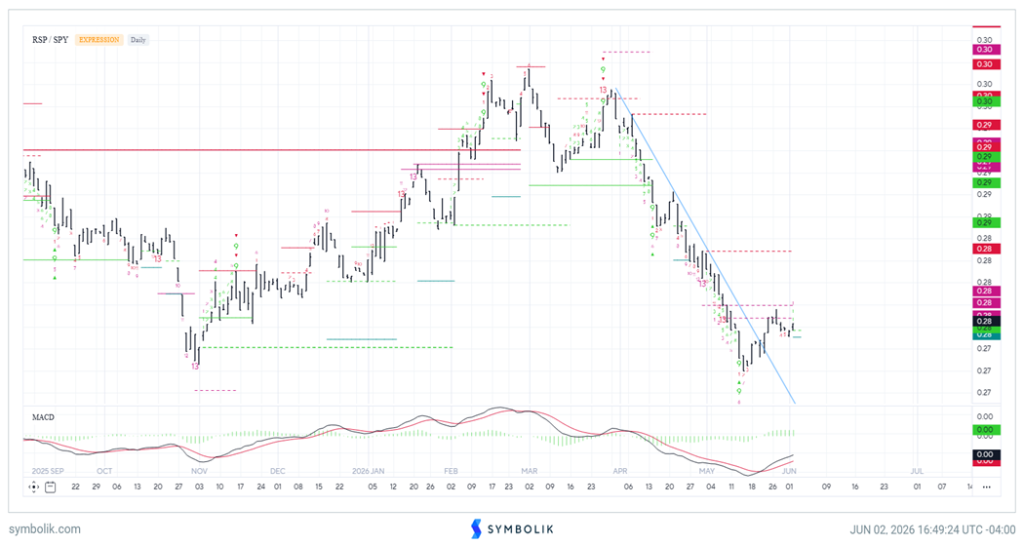
One positive with regard to the broader market involves the daily ratio of RSP (Equal-Weight S&P 500) versus SPY, which has begun to turn higher following a multi-month decline.
I read this as the start of a genuine rotation toward sectors outside of Technology, which so heavily dominates the cap-weighted SPY, and it argues for favoring the equal-weighted ^SPX over the cap-weighted index here. The move is early and still needs to show some follow-through, but coupled with the deterioration in the megacap leaders discussed below, it looks like the gradual beginning of the broadening out for US stocks, and it’s right to lean toward equal-weight exposure and the lagging non-Tech groups as this rotation gets underway.
While Consumer Discretionary has taken the early lead of non-Technology sectors in strengthening, I expect Industrials, Healthcare, and Financials to all show some strength in the months to come.
Equal-Weight S&P 500 vs. S&P 500 (RSP/SPY, daily) – Turning up from multi-month lows and has broken the downtrend as momentum starts to improve
Magnificent Seven breaks the rising trendline from late April on heavy volume, confirming the rotation
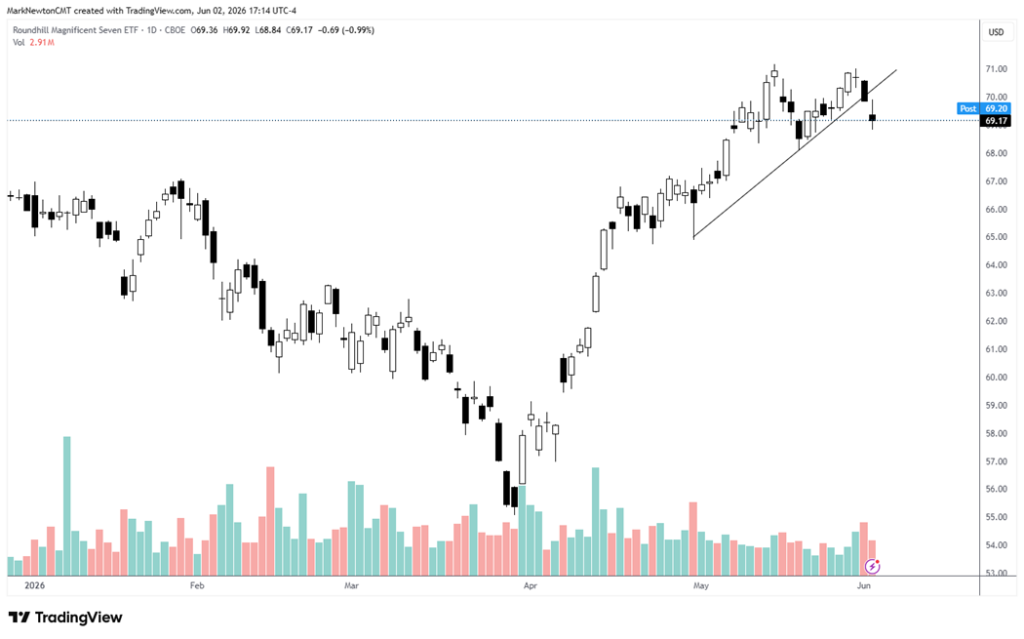
MAGS (Roundhill Magnificent 7 ETF) broke the rising trendline drawn off the late-April lows Tuesday, closing at 69.17 after stalling just shy of 71, and the break came on the heaviest volume since late April. This deterioration in the megacap leaders confirms the rotation signal from RSP/SPY: with Technology so dominant within the cap-weighted SPY, money leaving the Magnificent Seven is exactly what a move toward equal-weight looks like beneath the surface.
Rising volume on the recent breakdown suggests portfolio managers could be lightening large-cap Technology, the most plausible reason being to make room for the coming SpaceX IPO, which would pull capital out of the existing megacap complex to fund the new issue. While companies like Alphabet had a recent stock issuance, others like META, NFLX, and AMZN have all weakened over the last month.
In the short run, a single trendline break doesn’t count as heavily as a decline down under mid-May lows. However, it’s interesting that at a time when ^SPX and QQQ are pushing higher on lackluster breadth in recent weeks, MAGS has begun to weaken. Bottom line, it pays to respect the message and rotate rather than chase the megacap names here for those who are short-term oriented.
Roundhill Magnificent Seven ETF (MAGS, daily) – Breaks the rising trendline from the late-April lows on the heaviest volume since April, confirming the rotation toward equal-weight
IGV/SMH near multi-year lows with a weekly TD Buy Setup — favor Software over Semis on any Tech dip
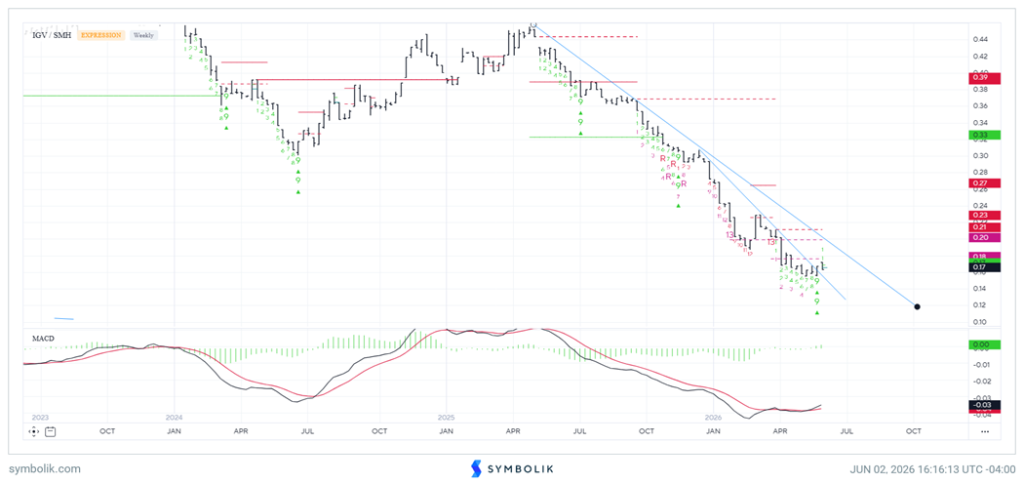
The weekly ratio of IGV (iShares Expanded Tech-Software Sector ETF) versus SMH (VanEck Semiconductor ETF) has begun to show meaningful evidence of stabilizing and starting to strengthen following its multi-month decline.
Weekly MACD has turned back up to cross the signal line off depressed levels, an encouraging momentum tell that this relationship could be bottoming after a long stretch of Software lagging Semis. This suggests Software has finally begun to strengthen enough that it can start to be favored vs. Semiconductors in small size. While more progress is necessary to help weekly momentum begin to improve, this recent development is a step in the right direction.
Furthermore, SMH looks quite stretched at current levels and shows both daily and weekly exhaustion signals (based on DeMark indicators) in unison this week. Similar to last night’s message regarding the Software sector starting to strengthen on an absolute basis, it looks right to give the Software leaders consideration here relative to Semiconductor stocks for those investors who are initiating new investments. My feeling is that Software should start to strengthen even further on a relative basis vs. Semiconductors over the next few months.
Software vs. Semiconductors (IGV/SMH, weekly) — Minor multi-month trendline being surpassed should allow Software to start to outperform and challenge the larger downtrend
XLI/SPY holds its rising relative trendline after a TD Buy Setup in the ratio of Industrials vs. S&P 500 — Industrials should be a broadening candidate
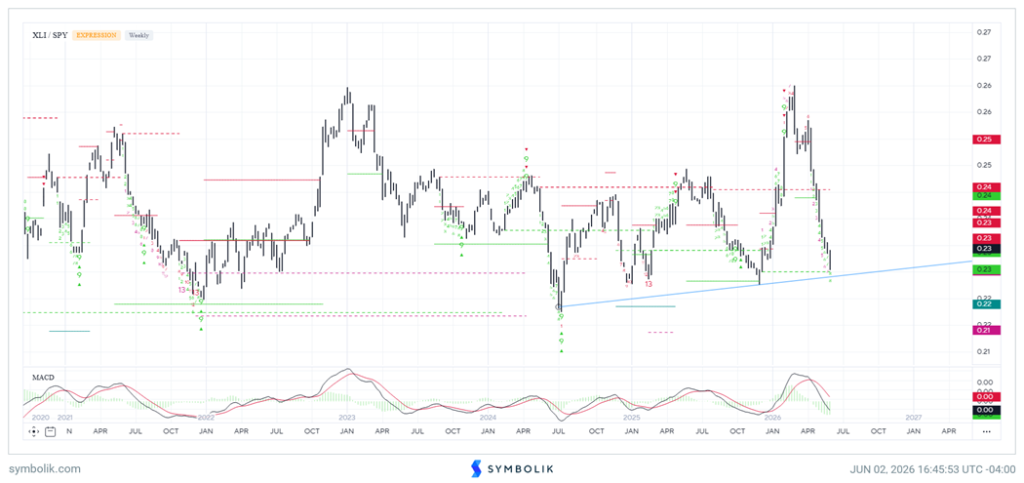
Industrials should be a sector to favor in the months to come following its sharp pullback to test a multi-year area of support vs. the S&P 500.
The weekly ratio of XLI (Industrials) versus SPY has pulled back to meaningful trendline support over the last week and should begin to turn back higher as the rotation toward non-Tech groups gets going.
While Industrials have underperformed in recent months, the recent pullback is now one week away from perfecting a TD Buy Setup (9 consecutive weekly closes below the prior close from four weeks prior). The combination of a TD Buy Setup on XLI vs. SPY following this pullback to meaningful monthly trendline support makes Industrials an attractive sector to favor ahead of a possible sustained Persian Gulf ceasefire.
Evidence of an official successful agreement with Iran should result in more meaningful selling pressure in WTI Crude, which would likely benefit Airlines and, by extension, Transportation — an important sub-sector of Industrials.
Overall, I like favoring XLI vs. SPY in the months ahead, expecting a pickup in relative strength that allows this ratio to bounce sharply.
Industrials vs. S&P 500 (XLI/SPY, weekly) – Holding the rising trendline near 0.23 after a TD Sell Countdown 13 registered at the recent relative highs
______________________________
PS: If you are enjoying our service and its evidence-based approach, please leave us a positive 5-star review on Google reviews —> Click here.