



“The soft overcomes the hard; the gentle overcomes the rigid. Everyone knows this is true, but few can put it into practice.” – Tao Te Ching
This July, the Pew Research Center reported a startling finding: in a poll of roughly 42,000 people in 36 countries, China is now viewed more favorably than the United States. Global opinion of the United States had rebounded after Trump 1.0 ended, but deteriorated slightly during the final year of the Biden presidency. After President Trump took office for the second time in 2025, those declines sharply accelerated.
Now, in 25 countries, a higher percentage of those polled had a significantly more favorable opinion of China than the U.S. In five, the numbers were roughly even.
Interestingly, of the six countries in which people still view the U.S. more favorably, four are Asian neighbors that have had overt territorial disputes with China in recent years. Meanwhile, however, residents of our own neighbors, Mexico and Canada, each now view China significantly more favorably, even though each country has also had its differences with China in recent years.
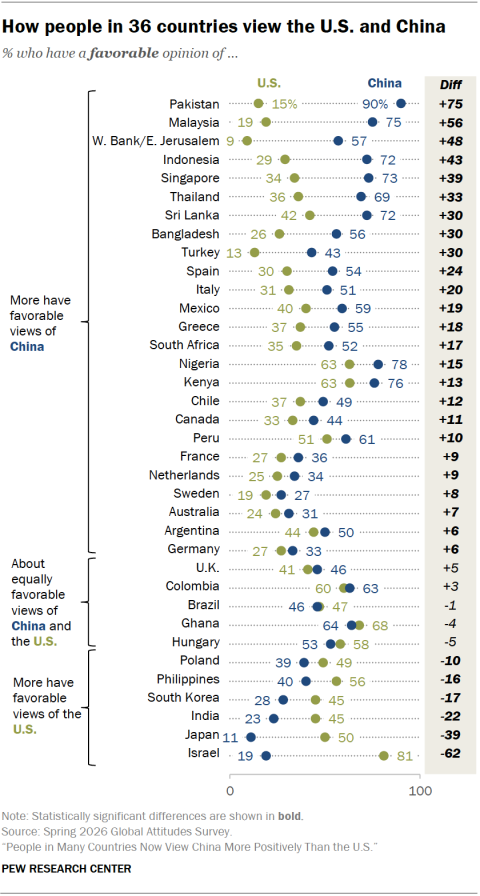
Diplomats sometimes refer to favorability numbers like this as a measure of soft power. That is to say that in contrast to hard power (military muscle and economic might, which can be used to exert overt pressure), soft power refers to a country’s ability to influence other countries, sometimes through culture (fashion, entertainment, etc.), shared political values, and foreign policy initiatives (disaster relief, for example).
For decades, the Pew Center has long been widely acknowledged as non-partisan and rigorous in its methodological soundness and lack of bias, though there are admittedly groups on both sides of the political spectrum who have occasionally disagreed with that assessment. Still, the survey’s findings are consistent with the recent “Chinamaxxing” trend, which still seems particularly well anchored within Gen Z. It arguably accounts for increased tourism to China, as well as increased adoption of Chinese lifestyle habits (drinking hot water, practicing Taijiquan, or getting cupping therapy, for example.)
Setting those aside, the survey results might seem unrelated to investments at a first glance. Many readers might not particularly care whether the U.S. is well-liked by the rest of the world. After all, what the poll is really doing is conducting a popularity contest, and why would that matter to stock-market investors?
Well, for starters, as Benjamin Graham and Warren Buffett have noted, the market often behaves much like a voting machine or popularity contest – particularly when it comes to short-term movements. Popularity affects returns.
Perhaps more notably, the trajectory of any individual publicly traded company is influenced by how investors view its industry, its sector, stocks in general – and yes, the country where it is based. In other words, a decline in the popularity of the U.S., even if one believes that the U.S. remains the greatest country in the world, should matter to investors.
There are analogous examples to support this thesis. The greatest salesperson in the world is likely to see lackluster results if selling on behalf of a hated company, but even a mediocre salesperson can bring in decent revenues if working for a highly respected one.
For investors, this sort of correlation has been well-known and well-documented when it comes to stocks and sectors/industries. Studies have shown that if a given sector is doing very well, the stock of even a mediocre company in that sector tends to get a boost. Conversely, if a sector has fallen out of favor, even a standout performer within that sector will likely see its stock battling headwinds. (See, for instance, Tobias J. Moskowitz and Mark Grinblatt’s “Do Industries Explain Momentum?” and Benjamin King’s seminal “Market and Industry Factors in Stock Price Behavior.”)
The link: U.S. stock performance, soft power, and technological dominance
It’s reasonable to hypothesize a similar effect when it comes to stock performance and country of origin. After all, the U.S. stock market became the best-performing one in the world around the same time that U.S. soft power became a dominant force around the world, which is also around the same time it began to set global standards for technology.
The S&P 500’s decades-long rise took place at the same time that blue jeans, rock & roll, and acknowledgement of the U.S. as the leader of the free world were in ascendancy, and both of those are linked to a separate but related feedback loop between U.S. technological dominance and U.S. soft power. Soft power enabled the U.S. to attract and keep the world’s best scientists, researchers, and engineers. In turn, they created technological marvels that enhanced the U.S. reputation for innovation while simultaneously enabling the U.S. to establish – and monetize – global technical standards and spread U.S. culture.
In other words, it can be argued that all three work together in a sort of flywheel, each enhancing the other two. Soft power facilitated incoming talent flows, encouraging smart, talented individuals to come study, learn, and create in the U.S. Those facilitated technological advances for the U.S. and thus, the ability to set – and monetize – global technical standards, global platforms, brand adoption, and overseas customer trust in the quality of U.S. goods and services. These, in turn, boosted the global embrace of U.S. culture, while the data from the resulting sales helps inform further innovation. All of those caused a net positive flow of revenues into the U.S., lowering the cost of capital for U.S. businesses and consumers.
Post-war history
After World War II, the U.S. built soft power through massive foreign aid programs such as, but not limited to, the Marshall Plan. Such programs helped build our reputation around the world as a net force for good in the world, and enhanced the U.S. ability to attract the greatest scientific minds in the world – drawing innovative talent that enabled the further improvement and dissemination of mass media technologies such as television broadcasting, Technicolor films, and the LP album.
These enabled U.S. music and movies to be exported to other countries: They’re why the world fell in love with Frank Sinatra and Elvis Presley, as well as The Magnificent Seven (the one with Steve McQueen and Yul Brynner, not Microsoft and Nvidia) and The Endless Summer, giving the U.S. a reputation for being not just smart and fair, but also fun and cool.

Not coincidentally, that’s also around the time that the U.S. developed transistors and space-exploration technology, with the global broadcast (using U.S. technology) of the Apollo moon landing demonstrating the superiority of U.S.-led democracy over the Soviet-led Communist bloc.
This strengthened the feedback loop: the soft power further enhanced our ability to attract academic and scientific expertise while also enhancing the global expansion and profitability of U.S. companies. In turn these successes increased our image, prestige, and influence abroad.
This loop continued to feed through the 1980s and beyond, as the U.S. developed – and set global technical standards for – personal and enterprise computing. That includes semiconductors designed to U.S. specifications, programming languages based on English, and the data transmission standards that formed the foundation for the internet and mobile networks. That’s how Windows became the de facto operating system for business and personal computers around the world, it’s how TCP/IP became the machine language of the internet, and then later, it’s how Google, Amazon, and Facebook conquered most of the world. This is a large reason why the iPod, and later on, the iPhone, became some of the world’s most desired gadgets, and most of those eschewing Apple carry a device running a Google-developed operating system.
Along the way, Europe and Japan, now economically recovered, began looking at the U.S. as an excellent place to invest, adding propulsion to the stock market boom of the go-go 1980s and beyond.
While the fundamentals behind that boom – U.S. ingenuity, strategic planning, and innovation – arguably deserve the largest share of that credit, it’s difficult to argue against the assertion that both innovation and global perception of U.S. investability owe a significant debt to the positive reputation enjoyed by the U.S. as a country and a culture. Customers around the world didn’t just buy into the technological accomplishments of Microsoft, Apple, and Google – they bought into the reputation of the country that first put a man on the moon.
That’s true for not just U.S. tech, but other sectors as well. For example, you can get a Quarter Pounder (aka Royale with Cheese) in most major cities on the planet, and with all due respect to the Golden Arches, it’s not because it’s a particularly tasty burger – or an inexpensive one, either. In many countries, it’s the connection with the U.S. that’s being sold – not the food itself or its value for money.
The flywheel is slowing
For those who follow such measures closely, the Pew report was not as much of a surprise. We’ve seen hints of that of late, such as the declining interest from international students in studying in the U.S. In January 2026, Brand Finance reported that the U.S. had recorded the steepest annual decline in its Global Soft Power score among any of the 193 countries assessed. Though the U.S. still leads China (barely) in overall soft power in this study, China bypassed the U.S. in the reputation metric. Brand Finance noted that the U.S. decline was rooted in declining perceptions in numerous other underlying metrics, among them generosity, good relations with other countries, friendliness, and ease of doing business – as well as governance indicators, such as human rights and rule of law.
A Gallup poll published in April reached similar conclusions. Every year, Gallup polls residents of 130 countries about the leadership of the four leading powers — the U.S., China, Russia, and Germany. Conducted before the beginning of hostilities in Iran this February, the Gallup poll showed that a greater percentage of respondents approved of China’s leaders than of the U.S. by 36% to 31%.
This is admittedly a lukewarm victory for China: “While low, China’s ratings have changed little by comparison,” noted Gallup. Furthermore, net approval ratings for both countries were negative (-1% China, -15% U.S.). Still, such a decline in approval for the U.S. leadership to below China levels has been seen in the Gallup poll only twice before – during the George W. Bush and Trump 1.0 administrations.
None of our discussion is meant to open a debate about whether President Trump has made the best choices for the U.S. during his second term thus far. Instead, it is to note that even if one believes them to have been sound decisions, those choices have nevertheless been detrimental to U.S. soft power. Not only does that matter, but its effects are arguably beginning to be seen.
Don’t believe me?
The modern equivalent of the 1960s space race is the current U.S. rivalry with China in the field of AI. On the obvious indicators, the U.S. maintains a definite lead, albeit one that in some respects has narrowed this year. Examining the leaderboards such as Vellum, Epoch AI (FrontierMath), LiveBench, and the LLM Leaderboard, all of which measure LLMs on various important measures of performance, we can see that models developed by U.S. companies like OpenAI, Anthropic, and Google make the most appearances.
So why is it that the rest of the world now tends to see China leading the U.S.?
In a survey published by U.K. pollsters Public First in June 2026, about 18,000 people across 15 countries, including the U.S., were asked which country is leading on “AI capability and innovation.” In 11 countries, more people answered “China” rather than the U.S.
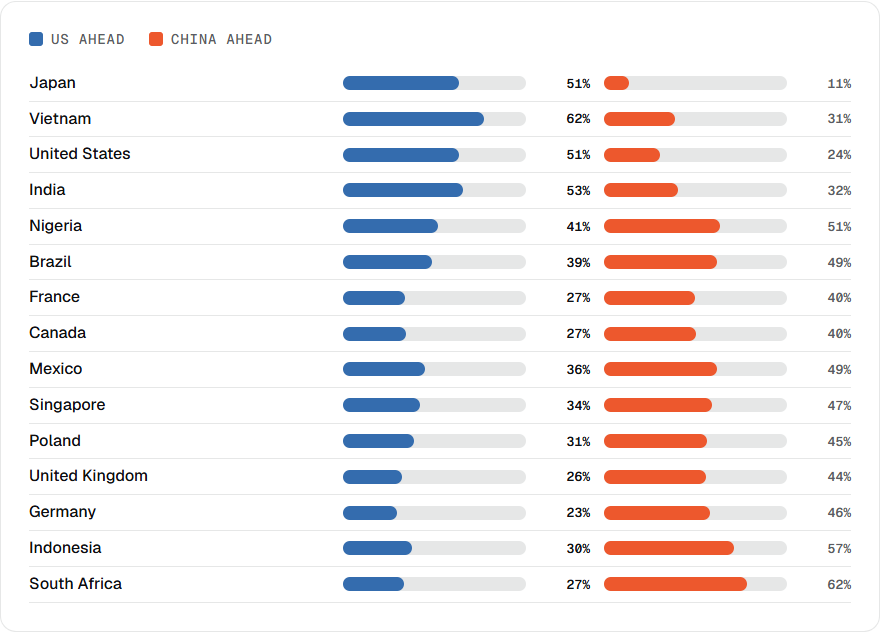
Reuters reported on Aug. 14 that the U.S. is “preparing to tell dozens of countries they must pick sides in the artificial intelligence race with China.” While it’s worth noting that the story has yet to be independently confirmed, there was a time when the need for such a request would have been seen as laughable. A decline in soft power could explain why that’s no longer the case.
It’s great that the U.S. companies are developing the most advanced AI models in the world. However, if the rest of the world doesn’t see the U.S. as the global leader in AI, and the rest of the world doesn’t see the U.S. as better than China, this will eventually impact the ability of those U.S. companies to monetize their accomplishments. Especially if customers abroad are explicitly forced to choose either the U.S. or China, but not both.
That should matter to investors.
If we are to look at the Cold War space-race precedent, I would hesitate to describe this as a “Sputnik moment.” The U.S. is still the AI leader and the world’s dominant economy. Nor does this shift in global public perception about the U.S. in general and U.S. AI efforts in particular portend an imminent collapse in the AI trade, in my view. However, for U.S. equity investors of any political affiliation, the disruption to the soft power/technological innovation flywheel matters, and if not corrected, it could eventually have a visible impact on stock-market returns.
As always, Signal From Noise should not be used as a source of investment recommendations but rather ideas for further investigation. We encourage you to explore our full Signal From Noise library, which includes a look at companies making “moonshot” bets, the investment trends driven by Gen Xers, the recent memory chip gold rush, the future of malls, and drone warfare. You can also find our take on space-exploration investments, defense stocks, and the business of farming.